
In past posts, I've discussed social media in light of standards and corporate responsibility. I received views from various parties, such as USC's Center for Telecom Management, PwC, and others.
Then I posted a link to IBM's reports on "Navigating the Media Divide."
As business and "social media" and forms of marketing evolve...we do see the need for standards and business models that incorporate standards. But how do you approach this from an international standpoint?
For example, iMediaConnection UK published the article, "Crossing the pond with your search engine marketing strategy", where Warren Cowan -- CEO of Greenlight -- refers to the need for cultural knowledge and domain knowledge to avoid not only case study-type marketing disasters but also for translating search campaigns to multi-country campaigns. But what does this mean in terms of standards and corporate responsibility?
Translation of words in meaning may have ethical but not legal liability, or vice versa or both. In using and interpreting "search data", what's the implication? Cowan refers to differences in quality and 'competitiveness of the term' and the impact on pay-per-click. What are the implications beyond pay-per-click ie. the use of this data? Cowan also describes the difference in rankings of international search engines and the need for strong multilingual and culturally fluent talent for site creation in non-domestic English-speaking regions.
The above example is from a marketer's perspective, but what about the impact on the user ie. the companies that go on to use the data obtained from search to develop user experiences or engage with users...?
Here's another example: a software company may produce a package for virtual meetings. Within this software is the capability for the "presenter" to hand over "remote access" to any member within the audience. Depending on the "presenter's" training/view of international relations...they may opt to give remote access to someone in say Burma. Now this Burmese audience member takes control over the presenter's computer to illustrate something within the presentation....However, the potential is there for the Burmese participant to have access to Internet websites that they otherwise wouldn't be allowed to or would be banned from usually in Burma. Potentially, the "presenter" could place the company, and even the country, and not to mention the Burmese, in a position of liability...why? Because a software was produced for sale with a remote function that technically "gets around" certain restrictive international "laws". And this software may have been developed based on "search data".
On another scale, we have privacy issues, such as a Facebook feature that shares what you automatically buy online without requesting consent to do so.
Marketers are developing strategies to "Get personal with your landing pages" -- to reach out to users on a more social and personal level. Although marketers should work to improve strategies, and all of us to improves products and services, we need to do so in a responsible manner.
PwC have produced two reports with US and International Perspective on the Rise of Lifestyle Media.
If standards are to be set for the multi-level use of social media,
1. Who should take the lead and who should be involved in developing these standards?
2. What should the business model look like that incorporates these standards?
3. How should standards be considered internationally?
Showing posts with label Corporate Responsibility. Show all posts
Showing posts with label Corporate Responsibility. Show all posts
Sunday, November 25, 2007


Monday, October 15, 2007
What's the meaning of Green Internet Services?
Yesterday I was researching e-book sites and knowledge sharing when I found a number of interesting things.
The first is an Ebook Share site where members can vote for "Which file host is faster?" Here's yesterday's results:

The first is an Ebook Share site where members can vote for "Which file host is faster?" Here's yesterday's results:
Out of all members on the Ebook Share site, 582 members bothered to vote and the results indicate that MiHD is the fastest file hosting service. So does fast mean eco-friendly?
------------------------------------------------------
I Googled for the solution (as you do) and I found EcoMatrix - "We provide a Eco friendly web hosting solutions and our servers are run on alternative energy sources and supplied by "GREEN" enviornmently conscious companies."
What are the eco-friendly web hosting solutions?
The alternate energy sources the servers are run on and the companies that EcoMatrix do business with.
Then I discovered Athenaem: Ecological Hosting with a far more extensive Green Mission:
Our Mission
We aim to operate the business based on our own ethics and principles.
To be the provider of choice for green Internet services.
Our Ethics
We are a debt free company operating entirely in the black on our bank account.
We use recycled paper for most of our office printing needs and aim to increase the use of recycled materials as more quality products become available.
We recycle used office paper and card.
We continually appraise our suppliers and our own procedures to reduce the amount of paper we use (e.g. email invoices, online banking, reusing envelopes, using online government systems for VAT returns etc).
We do not like waste and will not swap things just for the sake of it.
We try and specify computer equipment to last as long as possible without breaking the bank and always try to reuse equipment in a different role if it becomes no longer sufficiently powerful for its original purpose.
We always try to be open, honest and fair in our operation & procedures and to treat our customers as people, not just a number in a database.
The owner is a strict vegetarian and chooses to use green energy to supply electricity for his own home and office use.
We have gained Vegetarian Society approval to promote added confidence in our services for our vegetarian clients.
------------------------------------------------------
Irrespective of company size or industy type, using GREEN INTERNET SERVICES may mean the same or different things to various people according to their commitment to environmental causes.
For some, it may be the kind of food they order over the internet from a store that is envirnomentally conscious, through the transport they use, to those that they select for online banking and contracts in business. For others, it may be of lesser meaning and importance.
Internet services are used in every industry with such dependence. If being more environmentally-conscious and caring truly matters to us, then what does it mean to be Internet Green?
Internet Green Strategy:
1. How many eco-friendly involvements/causes do the CEO, VP's and executives support?
2. What types of eco-programs are your company involved with or sponsoring?
3. What is the eco-friendly rating of each vendor/supplier your company does business with? And how many eco-friendly vendors/suppliers does your company do business with?
4. How are your employees rewarded for eco-friendly behavior? Or what incentives are offered to employees for involvement in eco-friendly programs or activities?
5. What incentives are shared between partners or affilliates for eco-friendly behavior? What collaborative/exchange benefits can be gained from eco-schemes?
6. What energy sources are your servers and "systems" run on? And, when (where and how) can energy be conserved?
Saturday, September 22, 2007
PwC's David Phillips response to Social Media and CR
On 3 Sept 07, I asked David Phillips, PwC's senior corporate reporting leader in Assurance Practice, a question on the PwC corporate reporting blog:
David,
David,
Cisco says "People are in the center not computers"
"If the first wave of the Web Internet was largely defined by commerce and customer support (“find it, buy it, help it”), the second wave is more about rich collaboration (“find me, work with me”). The entrance of rich media and video into the equation shows how fast people-to-machine transactions are moving to people-to-people-to-contextual/real-time information types of interactions. People are in the center, not computers. And every device, fixed and mobile, is in play" - Alan S. Cohen, Vice President, Enterprise Solutions
Source: the_next_wave_of_the_business
Source: the_next_wave_of_the_business
Thursday, September 20, 2007
Death of Privacy by Social Media?
iMedia Connection Inc. have published an intriguing article today on the "Death of Privacy" due to Social Media:
Amelia Torode (Head of Digital Strategy VCCP) asks: "As individuals, the web has offered us so many opportunities to connect. We share everything, all the time, with everyone. But where is it all going?"
Torode refers to Emily Nussbaum's New Yorker publication "Say Everything" on teenage online behavior representing the greatest generation gap since rock-n-roll and suggests we read it.
BUT WHERE IS IT ALL GOING?
Nussbaum says: "The future belongs to the uninhibited."
Concluding paragraph:
"The benefits are obvious: The public life is fun. It’s creative. It’s where their friends are. It’s theater, but it’s also community: In this linked, logged world, you have a place to think out loud and be listened to, to meet strangers and go deeper with friends. And, yes, there are all sorts of crappy side effects: the passive-aggressive drama (“you know who you are!”), the shaming outbursts, the chill a person can feel in cyberspace on a particularly bad day. There are lousy side effects of most social changes (see feminism, democracy, the creation of the interstate highway system). But the real question is, as with any revolution, which side are you on?"
Torode says: "I think that by the end of this year we will move away from this era of radical transparency to one of refined privacy. Maybe we will find again that antiquated notion that sometimes silence is golden?"
Concluding paragraph:
Amelia Torode (Head of Digital Strategy VCCP) asks: "As individuals, the web has offered us so many opportunities to connect. We share everything, all the time, with everyone. But where is it all going?"
Torode refers to Emily Nussbaum's New Yorker publication "Say Everything" on teenage online behavior representing the greatest generation gap since rock-n-roll and suggests we read it.
BUT WHERE IS IT ALL GOING?
Nussbaum says: "The future belongs to the uninhibited."
Concluding paragraph:
"The benefits are obvious: The public life is fun. It’s creative. It’s where their friends are. It’s theater, but it’s also community: In this linked, logged world, you have a place to think out loud and be listened to, to meet strangers and go deeper with friends. And, yes, there are all sorts of crappy side effects: the passive-aggressive drama (“you know who you are!”), the shaming outbursts, the chill a person can feel in cyberspace on a particularly bad day. There are lousy side effects of most social changes (see feminism, democracy, the creation of the interstate highway system). But the real question is, as with any revolution, which side are you on?"
----------------------------------------------
Torode says: "I think that by the end of this year we will move away from this era of radical transparency to one of refined privacy. Maybe we will find again that antiquated notion that sometimes silence is golden?"
Concluding paragraph:
"It is fine for us grown-ups to know that we have to manage our own personal "brand," but much harder (if not impossible) for a teenager to realise that everything we do online has tracks, and this indeed is a scary thought. I wonder whether something like Ning and other micro-social networks are the way forward. Ning allows you to create your own bespoke network of "friends" based around specific passion points, so in my Ning account group I would not dream of posting pictures from my hen night, because I communicate about the professional world that I inhabit."
----------------------------------------------
I found both these conclusions thoughtful.
- Who promotes the death of privacy through social or online media?
- What are teenagers facing today that companies, schools, and families, do differently with use of online or social media and how does this impact on their sense of privacy?
- How are adults responding to social media and the "death of privacy"?
- Social media gives audiences across the board a voice - how does this impact not just individuals but entities?
Monday, September 10, 2007
RFID Journal introduces Distance Learning

What's interesting is not just the introduction of distance learning, but all the partnerships, collaborations, and alliances that result in product development, innovation, and forms of marketing too as a result. How social media is used to convey messages and the systems or platforms these media types run on - the compatibilities and incompatibilities - this is intriguing. More fascinating are all the conflicts of interest that may, can, and sometimes do arise with the dynamics of combining all these elements.
USC CTM Response on Social Media and CR
"I don’t think you will see, nor would it be a good development, standards for structure, content of social media. However, security issues, which is the one that triggered your original question, will most definitely generate demand for standards. Whether those turn out to be industry proposed, which is what is happening in finance industry when it comes to cyber security, or government imposed, which some in Congress argue for, or imposed through third parties such as auditing community remains to be seen. CTM’s sister institute, ICIIP (Institute for Critical Information Infrastructure Protection) has developed one model for such standards, Systemic Security Management, which is being actively reviewed by one of the leading international auditing communities."
Morley
Morley Winograd
Executive Director
USC Marshall
Center for Telecom Management (CTM)
Biography:
Morley Winograd is an internationally recognized authority on the impact of technology on life and work. Prior to joining CTM, he served as Vice President Gore's Senior Policy Advisor in the National Partnership for Reinventing Government. Since then, governments in Italy, Mexico, Israel, Costa Rica, and Argentina have asked him to help with their own reform efforts.
His lectures on the topic of technology's reshaping of America have won wide praise in forums as diverse as the Commonwealth Club of San Francisco, Los Angeles' Town Hall, Harvard's JFK School of Government, and Bologna University's John Hopkins School of International Affairs.
Prior to his work in government, Winograd spent eighteen years with AT&T, retiring as a Regional Vice President for Commercial Markets, having previously served as President of AT&T's University of Sales Excellence, a two-campus corporate training center that he reshaped into a university environment.
Morley is co-author of Taking Control: Politics in the Information Age (Holt, 1996). His innovative approach to corporate training has been recognized in such management training books as Stewardship, by Peter Block, and The Monster Under the Bed, by Stan Davis and Jim Botkin.
Source: http://www.marshall.usc.edu/web/CTM.cfm?doc_id=3979
Morley
Morley Winograd
Executive Director
USC Marshall
Center for Telecom Management (CTM)
Biography:
Morley Winograd is an internationally recognized authority on the impact of technology on life and work. Prior to joining CTM, he served as Vice President Gore's Senior Policy Advisor in the National Partnership for Reinventing Government. Since then, governments in Italy, Mexico, Israel, Costa Rica, and Argentina have asked him to help with their own reform efforts.
His lectures on the topic of technology's reshaping of America have won wide praise in forums as diverse as the Commonwealth Club of San Francisco, Los Angeles' Town Hall, Harvard's JFK School of Government, and Bologna University's John Hopkins School of International Affairs.
Prior to his work in government, Winograd spent eighteen years with AT&T, retiring as a Regional Vice President for Commercial Markets, having previously served as President of AT&T's University of Sales Excellence, a two-campus corporate training center that he reshaped into a university environment.
Morley is co-author of Taking Control: Politics in the Information Age (Holt, 1996). His innovative approach to corporate training has been recognized in such management training books as Stewardship, by Peter Block, and The Monster Under the Bed, by Stan Davis and Jim Botkin.
Source: http://www.marshall.usc.edu/web/CTM.cfm?doc_id=3979
Social Media & CR Example Continued...
I'll give you two personal examples, and they're just two in that multi-layered spectrum of the universe termed "social media":
1. My ISP is BT and they're teamed up with Yahoo! who provide me with an email service too. I have the Option 3 package for broadband - full bells and whistles unlimited - with firewall, virus and spyware protection...all that stuff.
While in the US I setup a Yahoo.com email account and I've continued to use that for personal US friends, etc. For UK purposes, I use the BT Internet Yahoo! account. There is also a Europe one which includes UK to my knowlege but I can't login through that with my BT Internet Yahoo! one.
When I'm using Yahoo.com and login to email...this is so called "personal communication", BT Internet slice in the middle of my email with a pop-up (even though I disable the pop-ups?) informing me that I have a BT Internet Yahoo! email account. Well, don't I already know that? And, do I want to be informed in the middle of an email just because BT have teamed up with Yahoo!?
It's all about marketing.
2. What I've also experienced while paying a student loan online with an international finance institution is that "in the middle of the transaction", a pop-up appears for another finance institution trying to sell me a loan product (?). What's going on?
3. I've always used Google as my default homepage. Well, Microsoft have apparently tried to take dominion a number of times because Google have warned me...another pop-up saying something to the effect that Google has blocked Microsoft from changing my default settings. Do I want to know all this?
It's all marketing, advertising and competition - using social media as a form of "predatorship". We all know it exists, but when it extends to financial products and online capabilities - shouldn't we ask questions?
Who do we ask...the ISP (in this case BT)...Yahoo!...the creators of the IT & infrastructures...the marketers advising these firms...who?
1. My ISP is BT and they're teamed up with Yahoo! who provide me with an email service too. I have the Option 3 package for broadband - full bells and whistles unlimited - with firewall, virus and spyware protection...all that stuff.
While in the US I setup a Yahoo.com email account and I've continued to use that for personal US friends, etc. For UK purposes, I use the BT Internet Yahoo! account. There is also a Europe one which includes UK to my knowlege but I can't login through that with my BT Internet Yahoo! one.
When I'm using Yahoo.com and login to email...this is so called "personal communication", BT Internet slice in the middle of my email with a pop-up (even though I disable the pop-ups?) informing me that I have a BT Internet Yahoo! email account. Well, don't I already know that? And, do I want to be informed in the middle of an email just because BT have teamed up with Yahoo!?
It's all about marketing.
2. What I've also experienced while paying a student loan online with an international finance institution is that "in the middle of the transaction", a pop-up appears for another finance institution trying to sell me a loan product (?). What's going on?
3. I've always used Google as my default homepage. Well, Microsoft have apparently tried to take dominion a number of times because Google have warned me...another pop-up saying something to the effect that Google has blocked Microsoft from changing my default settings. Do I want to know all this?
It's all marketing, advertising and competition - using social media as a form of "predatorship". We all know it exists, but when it extends to financial products and online capabilities - shouldn't we ask questions?
Who do we ask...the ISP (in this case BT)...Yahoo!...the creators of the IT & infrastructures...the marketers advising these firms...who?
Sunday, September 09, 2007
PwC Corporate Reporting Blog - Viewpoint on Social Media?
I've posed quite a broad question on David Phillips blog:
David,
Do you think that industry will eventually expect standards in social media as it impacts their products and services? I've posted a writeup on http://bizblogreview.blogspot.com/.
Links:
http://pwc.blogs.com/uk/2007/07/corporate-repor.html
http://pwc.blogs.com/corporatereporting/
David,
Do you think that industry will eventually expect standards in social media as it impacts their products and services? I've posted a writeup on http://bizblogreview.blogspot.com/.
Links:
http://pwc.blogs.com/uk/2007/07/corporate-repor.html
http://pwc.blogs.com/corporatereporting/
Friday, September 07, 2007
Social Media and Corporate Responsibility

Rough Mind Map - Social Media & Finance Industry Example.
At the start of the week two people were discussing Social Media with me when one mentioned the word "Insurance" - this was what my mind mapped. Take out the finance industry as just one example.
A major area for social media is distance learning. Social media brings learning to life and companies (VISA, RBS, HSBC) in the UK are getting the ifs (and similar institutes) to customize learning products for them:
http://www.ifslearning.com/home/default.cfm
They also have ifsProshare and KnowledgeBank.
Tremendous changes are happening in the finance industry. We'll take this term - finance - to include the accounting and investment fields...because where Corporate Responsibility (CR) auditing is concerned - there will be an overlap in the future: http://www.pwc.com/Extweb/service.nsf/docid/
976C40E302D62DA980256BC1003D7DA7
Reporting that extends to economic, social, and environmental sustainability - below and beyond the "reporting threshold".
PwC are an industry leader in setting the standards for global implementation of IFRS which used to be known as the "International Accounting Standards Board" (IASB). The words "Financial Reporting Standards" have replaced "Accounting Standards Board".
In 2009, the International Financial Reporting Standards is proposing to merge with US GAAP:
http://www.pwc.com/gx/eng/about/svcs/
corporatereporting/WW2_06Convergence.pdf
Differences between IFRS and US GAAP:
http://www.pwc.com/extweb/pwcpublications.nsf/
docid/74d6c09e0a4ee610802569a1003354c88
Consider the impact on large and small business, and on academic institutions teaching financial-related courses. Changes will have to be made. Are preparations being made?
In 2004, when I took Accounting courses at university, no mention was ever made of IFRS in the class. Since global changes in financial regulation and reporting standards are so important -students should be kept in the loop.
In November 2007, Markets in Financial Instruments Directives (MiFID) takes effect extending the responsibility of firms in their conduct of business and internal organization - CR.
The Financial Services Authority (FSA) in the UK have implemented "Treating Customers Fairly" - also CR. And it's the FSA that provide institutes like the ifs with syllabus guidelines, and industry with codes of conduct.
Firms are operating internationally, and so are educational institutes - all are using social media. What's interesting is the dependence we have on social media - especially in distance learning.
As PwC forges ahead to set the standards in global CR for finance - which company should set the global standard for social media? Google? Yahoo? Should marketers be curators of content? What are the conflicts of interest? What protections are in place for profiles and content?
The answers to these questions need to be explored. Our reliance appears to be on marketers as the promoters of social media to answer them. We see division, such as with the Wikimedia Foundation and the Founders of Centiare. Does or should a multi-industry group exist to independently evaluate and answer these questions?
Monday, March 27, 2006
Business Week MBABlog -- "Teaching Ethics in Business Schools"
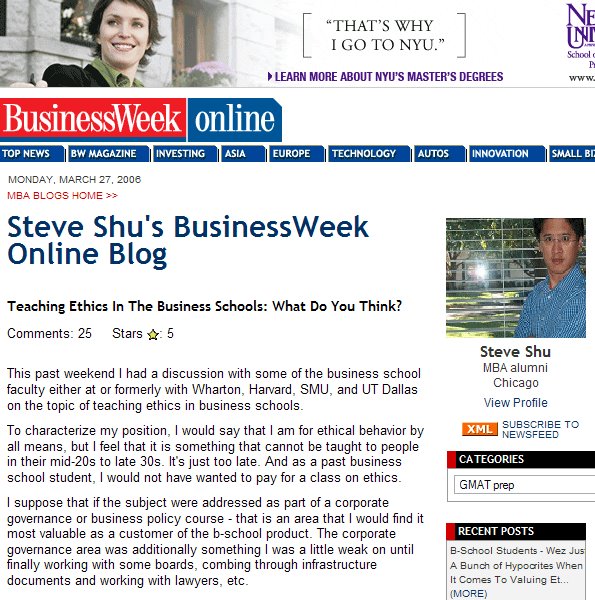 (Click to enlarge picture)
To quote Steve Shu:
"But I think in my discussions with the b-school professors, I think the position I hold (which is not so optimistic about teaching ethics in the business schools) is a minority position. The general consensus seemed to be that ethics should be taught more actively in business schools. That leaders need to have such skills" [http://steveshu21pub.mbablogs.businessweek.com
/weblogEntry/1444m0w9utpyc.htm].
Steve's position is that although he is for ethics, he doesn't think people in their mid-20's to late 30's can be taught ethics.
Ethics Cases In Point:
USC's Marshall School of Business, Center for Management Communication, offers an excellent special interest (previously BUAD 499) "Ethics, Independent Research, and Public Communications" class. Students (in their mid-20's to 30's) actually partake in real-life ethics cases to learn how to recognize specific ethical dilemmas and to seek solutions to these real-life ethical problems.
My response to you, Steve, is that irrespective of age, it depends on what is important and of interest to you.
Although ethics is debatable in perspective, business students can and should learn strategies to identify and deal with ethical issues in the workplace.
If employees (post-undergraduate and post-graduate) face ethical dilemmas and cannot recognize them or identify strategies and solutions to resolve the issues through social responsible means, and if Enron and Worldcomm executives are sentenced for legal and ethical violations -- then there clearly is a need for ethics training on the undergraduate and graduate level.
Ethics is a foundation on which to build corporate goals that includes corporate policy/governance/responsibility. Students should learn and build on that foundation.
Thursday, March 23, 2006
Steps for CEO's to earn a good reputation with bloggers
Andy Sernovitz, CEO of Word Of Mouth Marketing Association (WOMMA), suggests five steps CEO's can follow to earn a good reputation with bloggers at this link:[http://www.imediaconnection.com/content/7780.asp].
The Five Steps:
1. Follow the conversation
2. Participate
3. Show that you are listening
4. Convert critics when you can
5. Write for the record
Sernovitz addresses how CEO's can reduce the confusion on whether to "Talk to them [bloggers], ignore them, treat them as press, treat them as customers, do your own blog, comment on their blog" with the following advice:
* The last word counts most
* Recent posts get indexed
* Everything lasts forever on Google
And what this means for CEO's is that:
* You'll never be able to control the blogosphere conversation
* You'll never be able to manage your own blog coverage like you could with the press
* You should respond participate (not plant and initiate), earn respect, and tell your story
* Let your views be heard and end the dialogue on a positive note
* Let your own words speak for themselves, do not try to manage what other people say
* Become part of the online community
Secret of Blog Relations = Customer Service
"It's working with a vocal group of individuals who each have their own particular concerns and needs. It's looking at situations, addressing them, and getting them fixed however you can", says Sernovitz.
So CEO's need to:
1. Treat bloggers like important customers
2. Earn their respect through service and respect
3. Use metrics to track positive and negative comments -- how quickly you respond to concerns
4. Look at the percentage of issues resolved successfully and for ways to improve the resolution rate
The conclusion says Sernovitz, "So if you want a good rep [reputation] in the blogosphere, you need to be good."
BE GOOD!
The Five Steps:
1. Follow the conversation
2. Participate
3. Show that you are listening
4. Convert critics when you can
5. Write for the record
Sernovitz addresses how CEO's can reduce the confusion on whether to "Talk to them [bloggers], ignore them, treat them as press, treat them as customers, do your own blog, comment on their blog" with the following advice:
* The last word counts most
* Recent posts get indexed
* Everything lasts forever on Google
And what this means for CEO's is that:
* You'll never be able to control the blogosphere conversation
* You'll never be able to manage your own blog coverage like you could with the press
* You should respond participate (not plant and initiate), earn respect, and tell your story
* Let your views be heard and end the dialogue on a positive note
* Let your own words speak for themselves, do not try to manage what other people say
* Become part of the online community
Secret of Blog Relations = Customer Service
"It's working with a vocal group of individuals who each have their own particular concerns and needs. It's looking at situations, addressing them, and getting them fixed however you can", says Sernovitz.
So CEO's need to:
1. Treat bloggers like important customers
2. Earn their respect through service and respect
3. Use metrics to track positive and negative comments -- how quickly you respond to concerns
4. Look at the percentage of issues resolved successfully and for ways to improve the resolution rate
The conclusion says Sernovitz, "So if you want a good rep [reputation] in the blogosphere, you need to be good."
BE GOOD!
Sunday, February 19, 2006
Will Bob Royce - iUpload - answer my question?

(Click on picture to enlarge)
Tonight, I posted a question on Bob Royce's blog as follows:
"Many teens are using sites, such as MySpace.com, posting personal information that leaves a trail detectable by future prospective employers. Even when bloggers on blogger.com delete posts, the entries are still accessible via google search. What responsibility do you think initiators of blog software, such as blogger.com, have to educating youngsters, and other users, on their sites prior to registration about the pitfalls of blogging blindly?"
Although I am in the process of emailing a number of executives with questions about blogs, this is the first comment that I have posted on an executive blog.
Monday, February 13, 2006
What does BusinessWeek say about "Blogspotting"?
Corporate blog search is a monster growth area!
Stephen Baker says: "Long story short: Corporate blog and media search will be a busy intersection in coming years. Lots of development, conflicts, alliances, and M&A" (Business Week).
Stephen Baker says: "Long story short: Corporate blog and media search will be a busy intersection in coming years. Lots of development, conflicts, alliances, and M&A" (Business Week).
Subscribe to:
Posts (Atom)


Do you think that industry will eventually expect standards in social media as it impacts their products and services? I've posted a writeup on http://bizblogreview.blogspot.com.
David's response:
Fiona, I think you pose an interesting question. I think the promotion of products and services through the social media is at an early stage of its evolution, as is normally the case industry and society are happy for it to evolve as no one has been badly damaged. As with most things I am sure a point will come when industry may try to impose some form of standards (clearly at the moment some companies impose their own standards for accreditation) to ensure that individuals are not mislead and damaged by the irresponsible actions of a few.