
In past posts, I've discussed social media in light of standards and corporate responsibility. I received views from various parties, such as USC's Center for Telecom Management, PwC, and others.
Then I posted a link to IBM's reports on "Navigating the Media Divide."
As business and "social media" and forms of marketing evolve...we do see the need for standards and business models that incorporate standards. But how do you approach this from an international standpoint?
For example, iMediaConnection UK published the article, "Crossing the pond with your search engine marketing strategy", where Warren Cowan -- CEO of Greenlight -- refers to the need for cultural knowledge and domain knowledge to avoid not only case study-type marketing disasters but also for translating search campaigns to multi-country campaigns. But what does this mean in terms of standards and corporate responsibility?
Translation of words in meaning may have ethical but not legal liability, or vice versa or both. In using and interpreting "search data", what's the implication? Cowan refers to differences in quality and 'competitiveness of the term' and the impact on pay-per-click. What are the implications beyond pay-per-click ie. the use of this data? Cowan also describes the difference in rankings of international search engines and the need for strong multilingual and culturally fluent talent for site creation in non-domestic English-speaking regions.
The above example is from a marketer's perspective, but what about the impact on the user ie. the companies that go on to use the data obtained from search to develop user experiences or engage with users...?
Here's another example: a software company may produce a package for virtual meetings. Within this software is the capability for the "presenter" to hand over "remote access" to any member within the audience. Depending on the "presenter's" training/view of international relations...they may opt to give remote access to someone in say Burma. Now this Burmese audience member takes control over the presenter's computer to illustrate something within the presentation....However, the potential is there for the Burmese participant to have access to Internet websites that they otherwise wouldn't be allowed to or would be banned from usually in Burma. Potentially, the "presenter" could place the company, and even the country, and not to mention the Burmese, in a position of liability...why? Because a software was produced for sale with a remote function that technically "gets around" certain restrictive international "laws". And this software may have been developed based on "search data".
On another scale, we have privacy issues, such as a Facebook feature that shares what you automatically buy online without requesting consent to do so.
Marketers are developing strategies to "Get personal with your landing pages" -- to reach out to users on a more social and personal level. Although marketers should work to improve strategies, and all of us to improves products and services, we need to do so in a responsible manner.
PwC have produced two reports with US and International Perspective on the Rise of Lifestyle Media.
If standards are to be set for the multi-level use of social media,
1. Who should take the lead and who should be involved in developing these standards?
2. What should the business model look like that incorporates these standards?
3. How should standards be considered internationally?
Showing posts with label PwC. Show all posts
Showing posts with label PwC. Show all posts
Sunday, November 25, 2007


Saturday, September 22, 2007
PwC's David Phillips response to Social Media and CR
On 3 Sept 07, I asked David Phillips, PwC's senior corporate reporting leader in Assurance Practice, a question on the PwC corporate reporting blog:
David,
David,
Tuesday, September 11, 2007
PwC Advertise on Facebook

It's fascinating how corporations are tapping into the use of social media for marketing purposes. Here's an example of my Facebook account where I'm responding to a friend at USC and we're discussing careers. I happened to mention PwC with the web link and what pops up? This thumbnail advertisement. Notice though, I have the choice to remove it and also to choose a picture or no picture before clicking "send". Facebook users have free access to this utility and receive no commission for being "instruments of advertising or marketing". Versus the partnership that exists between Facebook (soon-to-be-Google) and advertisers/marketers.
Sunday, September 09, 2007
PwC Corporate Reporting Blog - Viewpoint on Social Media?
I've posed quite a broad question on David Phillips blog:
David,
Do you think that industry will eventually expect standards in social media as it impacts their products and services? I've posted a writeup on http://bizblogreview.blogspot.com/.
Links:
http://pwc.blogs.com/uk/2007/07/corporate-repor.html
http://pwc.blogs.com/corporatereporting/
David,
Do you think that industry will eventually expect standards in social media as it impacts their products and services? I've posted a writeup on http://bizblogreview.blogspot.com/.
Links:
http://pwc.blogs.com/uk/2007/07/corporate-repor.html
http://pwc.blogs.com/corporatereporting/
Monday, March 06, 2006
Points to Note: Why Mohammed Amin Blogs
As a corporate blogger, Mohammed Amin considers a number of points as follows:
- Corporate blogs are more spontaneous, more personal, and require fewer vetting-levels than corporate websites that require multiple levels of approval.
- Corporate bloggers, such as Mohammed Amin, are able to exhibit their personal style that is associated with the corporation (giving the corporation a "personal face").
- Corporate bloggers extend a welcome and showcase of their expertise to companies that seek their professional services.
- Referencing the corporate blog in the signature space of emails enables existing business contacts to visit the blog.
- A challenge is to have the time to create original posts on a regular basis.
PWC - Why Mohammed Amin Blogs
On February 19, 2006, I emailed Mr. Mohammed Amin - International Taxation Specialist at PriceWaterhouseCoopers - with some questions about his corporate blog. And he kindly took the time to answer these questions for me via email on February 21, 2006 - here they are:
QUESTION:
What prompted you to start your corporate blog?
ANSWER:
"I started this blog after a suggestion from my colleagues who are responsible for coordinating the tax element of our web presence for the UK firm. As you will be aware, our website, www. pwc.com is enormous, with sections for countries and lines of service. Due to the nature of the site, multiple levels of approval are needed before changes can be made."
QUESTION:
What are some of the benefits/drawbacks that you experience from having the blog?
ANSWER:
"The blog offered the scope to have something much more spontaneous and more personal. I appreciate that developments in a specialist tax field may not sound very personal, but everything is a matter of degree. The key message is that what goes on the site is determined and written entirely by me. However, as it is also PwC speaking, I still have the material vetted before posting by a colleague for technical accuracy, and by people from our corporate communications department to ensure that they are happy with me saying it. Despite this vetting, it still has a much more personal style than our main website."
"My goal was to extend my reach in disseminating our expertise on this subject. I think it has been achieved, in that many of the visitors to the blog do come from the type of companies that we want to reach. It is also worthwhile having my existing business contacts look at the blog, as it allows us to showcase our expertise. For that reason, I have the reference to the blog in the signature space of my emails.The main challenge I have faced is coming up with things to write about. I set out with the aim of one posting per week, but am probably averaging nearer one per fortnight."
Mohammed Amin MA FCA AMCT CTA (Fellow)
Read my Finance & Treasury blog at
http://pwc.blogs.com/mohammed_amin
QUESTION:
What prompted you to start your corporate blog?
ANSWER:
"I started this blog after a suggestion from my colleagues who are responsible for coordinating the tax element of our web presence for the UK firm. As you will be aware, our website, www. pwc.com is enormous, with sections for countries and lines of service. Due to the nature of the site, multiple levels of approval are needed before changes can be made."
QUESTION:
What are some of the benefits/drawbacks that you experience from having the blog?
ANSWER:
"The blog offered the scope to have something much more spontaneous and more personal. I appreciate that developments in a specialist tax field may not sound very personal, but everything is a matter of degree. The key message is that what goes on the site is determined and written entirely by me. However, as it is also PwC speaking, I still have the material vetted before posting by a colleague for technical accuracy, and by people from our corporate communications department to ensure that they are happy with me saying it. Despite this vetting, it still has a much more personal style than our main website."
"My goal was to extend my reach in disseminating our expertise on this subject. I think it has been achieved, in that many of the visitors to the blog do come from the type of companies that we want to reach. It is also worthwhile having my existing business contacts look at the blog, as it allows us to showcase our expertise. For that reason, I have the reference to the blog in the signature space of my emails.The main challenge I have faced is coming up with things to write about. I set out with the aim of one posting per week, but am probably averaging nearer one per fortnight."
Mohammed Amin MA FCA AMCT CTA (Fellow)
Read my Finance & Treasury blog at
http://pwc.blogs.com/mohammed_amin
Saturday, February 18, 2006
PriceWaterHouseCooper Blogger -Mohammed Amin
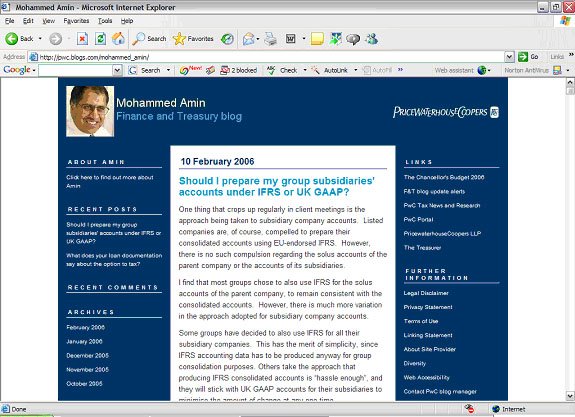
(Click picture to enlarge)
Mohammed Amin's Finance and Treasury Blog is Powered by Typepad and was started in October 2005.
Mohammed Amin is a Specialist in Taxation of Foreign Exchange, Derivatives, and Corporate Debt at PriceWaterHouseCoopers.
The blog currently features the following advice on implications when changing from UK GAAP (Generally Accepted Accounting Principles) to EU-endorsed IFRS (International Finance Reporting Standards):
"Very briefly, changing from UK GAAP to IFRS will have three possible implications for the computation of profits for accounting and tax purposes."
- Profits may be accelerated. In certain cases, IFRS requires faster revenue recognition than does UK GAAP. Under IFRS may require them to be recognised immediately upon receipt as income.
- Profits may be decelerated. IFRS may require a higher level of provisioning for certain types of risk, or otherwise defer the recognition of income.
- There may be little change.
Subscribe to:
Posts (Atom)


Do you think that industry will eventually expect standards in social media as it impacts their products and services? I've posted a writeup on http://bizblogreview.blogspot.com.
David's response:
Fiona, I think you pose an interesting question. I think the promotion of products and services through the social media is at an early stage of its evolution, as is normally the case industry and society are happy for it to evolve as no one has been badly damaged. As with most things I am sure a point will come when industry may try to impose some form of standards (clearly at the moment some companies impose their own standards for accreditation) to ensure that individuals are not mislead and damaged by the irresponsible actions of a few.