
In past posts, I've discussed social media in light of standards and corporate responsibility. I received views from various parties, such as USC's Center for Telecom Management, PwC, and others.
Then I posted a link to IBM's reports on "Navigating the Media Divide."
As business and "social media" and forms of marketing evolve...we do see the need for standards and business models that incorporate standards. But how do you approach this from an international standpoint?
For example, iMediaConnection UK published the article, "Crossing the pond with your search engine marketing strategy", where Warren Cowan -- CEO of Greenlight -- refers to the need for cultural knowledge and domain knowledge to avoid not only case study-type marketing disasters but also for translating search campaigns to multi-country campaigns. But what does this mean in terms of standards and corporate responsibility?
Translation of words in meaning may have ethical but not legal liability, or vice versa or both. In using and interpreting "search data", what's the implication? Cowan refers to differences in quality and 'competitiveness of the term' and the impact on pay-per-click. What are the implications beyond pay-per-click ie. the use of this data? Cowan also describes the difference in rankings of international search engines and the need for strong multilingual and culturally fluent talent for site creation in non-domestic English-speaking regions.
The above example is from a marketer's perspective, but what about the impact on the user ie. the companies that go on to use the data obtained from search to develop user experiences or engage with users...?
Here's another example: a software company may produce a package for virtual meetings. Within this software is the capability for the "presenter" to hand over "remote access" to any member within the audience. Depending on the "presenter's" training/view of international relations...they may opt to give remote access to someone in say Burma. Now this Burmese audience member takes control over the presenter's computer to illustrate something within the presentation....However, the potential is there for the Burmese participant to have access to Internet websites that they otherwise wouldn't be allowed to or would be banned from usually in Burma. Potentially, the "presenter" could place the company, and even the country, and not to mention the Burmese, in a position of liability...why? Because a software was produced for sale with a remote function that technically "gets around" certain restrictive international "laws". And this software may have been developed based on "search data".
On another scale, we have privacy issues, such as a Facebook feature that shares what you automatically buy online without requesting consent to do so.
Marketers are developing strategies to "Get personal with your landing pages" -- to reach out to users on a more social and personal level. Although marketers should work to improve strategies, and all of us to improves products and services, we need to do so in a responsible manner.
PwC have produced two reports with US and International Perspective on the Rise of Lifestyle Media.
If standards are to be set for the multi-level use of social media,
1. Who should take the lead and who should be involved in developing these standards?
2. What should the business model look like that incorporates these standards?
3. How should standards be considered internationally?
Showing posts with label IBM. Show all posts
Showing posts with label IBM. Show all posts
Sunday, November 25, 2007


Sunday, October 28, 2007
Social Networks as Ad Platforms – How appealing is that to society?
With Microsoft’s $240m investment in a 1.6 percent stake of Facebook for advertising and growth opportunity purposes, I do wonder what form this will take.
Recent notable changes to Facebook include applications (among others), such as iRead, iLike and Flixster where users can upload the books, music, and movies they enjoy to rate, review, and discuss with others. A book I am currently reading didn’t feature on iRead’s selection, so I was able to upload it from Amazon.com. Sharing such interests is still a digestible form of promotion while partaking in social network.
However, if Facebook opt for a similar incentive model introduced on MySpace, such as Vivasearch (or the like), it may be detrimental to the quality of the network. Users appear to sign up with organizations like Vivasearch to earn profit by adding “friends” on MySpace.

The concept is similar to the IndieClick model where media/marketing professionals “work with advertisers and agencies to deliver relevant and targeted messaging to our discerning audience of more than twenty-eight million 16-34 year old “Influencers” and tastemakers.”
 What this could smack of, depending on delivery, are those pyramid-type schemes.
In a recent study (discussed more in-depth further on) IBM interviewed executives about challenges in new content and distribution strategies. Here are the results:

Back in June 2007, FOOA (Future of Online Advertising), featured an article on “Deciphering trends in online advertising.” IndieClick is the topic of discussion in this article, but what I found of interest are:
- Things that affect the landscape of online advertising (Digital Rights Management, disintegration of content from platform, consolidation of major players, remnant players expanding into premium markets, new forms of media, new hardware)
- Audience’s acceptance of new forms of advertising
- Advances in ad-serving technology
- Flight of talent from print and television
- Online advertising metrics
After posting Google’s Terms and Conditions to Biz Blog Review, I wondered how Google (if they had got the Facebook stake instead of Microsoft) would have approached this ad platform or “landscape”. A comparison of Microsoft-Google approaches may give us an idea of two different Facebook user social experiences/experiments in advertising.
On visiting the IBM site, I discovered the article “The fight ahead on media’s main streets” produced in February 2007 highlighting how user-generated content and open distribution platforms are shaking up the media industry:
“A new media world has arrived. Pioneered by teens and gadget-savvy professionals, it has quickly spread into virtually every consumer segment, and started to encroach on traditional media. The number of unique visitors to MySpace.com has now surpassed the 50 million mark – something akin to the number of U.S. households that tune into the Super Bowl.1 Every day, consumers around the world watch about 100 million videos on YouTube – putting that number in context, the top 15 British primetime television shows combined attract about 100 million viewers, as do the top 4 U.S. shows.2
To examine the inherent tension between new and traditional media and explore future industry scenarios, we conducted a comprehensive study that included interviews with leaders of media companies and an in-depth analysis of the factors that are shaping the industry outlook” – IBM.
Through the analysis, IBM identify four business models co-existing – Traditional media (The Walt Disney Company), Walled communities (NTT DoCoMo), Content hyper-syndication (BBC with My BBC interactive media service), New platform aggregation (YouTube, MySpace, Second Life) – with a blur of the models over time as media companies experiment into 2010.
While the revenue of new media channels is expected to reach US$55 billion in 2006 with a Compound Annual Growth Rate (CAGR) of 23 percent to 2010, traditional channels are expected to generate US$455 billion in revenue in 2006 with a CAGR of 6 percent.
The study shows the drivers of change and the catalysts of the conflict between new media and traditional channels to be:
- Device and access rollout
- Multichannel content innovation
- New consumer behavior and roles
- Faster revenue to attention alignment
According to IBM – available bandwidth, interactive media possibilities, falling prices of sophisticated media editing and recording equipment and software – “have put the tools of the trade within reach of almost any aspiring talent or wannabee. The result is a blurring and merging of the roles of producer and consumer, or a “prosumer,” as coined by Alvin Toffler.”
And what happens when media companies start experimenting with the role of the “prosumer” (producer + consumer) as “prosumermoter” (producer + consumer + promoter)?
One aspect may be the review of industry standards. IBM report:
“Government policy affects consumer pricing for access and content, piracy rules and their enforcement, network usage and competitive neutrality, business conditions for entrepreneurs, just to name a few areas. In addition, as telecommunications and media industry boundaries blur, companies are often subject to two sets of regulators, instead of one. For the foreseeable future, regulation remains a critical factor that can accelerate or derail new initiatives or strategies.”
In this analysis, IBM identifies options and provides ten recommendations for industry:
- Put consumers at the center of your business and boardroom.
- Convert consumer data into competitive advantage.
- Give control to get share.
- Deliver experiences, not just content.
- Leverage virtual worlds.
- Innovate business models.
- Invest in interactive, measurable advertising services and platforms
- Redefine partnerships, while mitigating fallout.
- Shift investment from traditional business to new models.
- Create a flexible business design.
In a society where consumers want to create unconstrained by distributors’ conditional access controls, IBM suggests industry incumbents should review the timing and completeness of response to “prosumers” (and partners), offering opportunity for growth and experience instead of conflict.
Saturday, April 01, 2006
Bob Sutor's advice to students on how to address corporate executives when blogging
Hi, Fiona, this is Bob Sutor.
Thanks for all the attention you've given my blog. It's definitely something that is evolving as am I in my thinking about it and how to make it effective. One thing that might be interesting to look at is the pschology of the blog in the sense that they ebb and flow in terms on content and whether they seem to be upbeat or less optimistic. You asked me in the comment to my blog if it is fine to address me as "Bob" in the comments. Absolutely! Note, though, that if someone uses a very formal name in their Blog "Dr So and So" then it is probabbly best to use the title. This is probably more applicable outside the US, but people should bear it in mind.
Bob
Thanks for all the attention you've given my blog. It's definitely something that is evolving as am I in my thinking about it and how to make it effective. One thing that might be interesting to look at is the pschology of the blog in the sense that they ebb and flow in terms on content and whether they seem to be upbeat or less optimistic. You asked me in the comment to my blog if it is fine to address me as "Bob" in the comments. Absolutely! Note, though, that if someone uses a very formal name in their Blog "Dr So and So" then it is probabbly best to use the title. This is probably more applicable outside the US, but people should bear it in mind.
Bob
Thursday, March 30, 2006
USC Marshall School -- Top Of The Blog!
Today I received wonderful news -- USC Marshall School of Business, Center for Management Communication, are crafting an upcoming course in Communications Management that will cover online communities and blogging for business!
Also, IPT hosted an open house tonight on "Relevance of Technology to Careers in Business". Although I was unable to attend, I look forward to hearing the outcome of this event.
By recognizing the impact of technology in business and therefore in the classroom, and by tailoring courses accordingly, the Marshall School of Business will prepare students to meet opportune moments with confidence and success.
Dr. Sandra Chrystal from USC's Center for Management Communication is one of the earliest pioneers in the field of blogging, wikis, podcasting, and PRS technology to enhance student learning.
On Tuesday, I presented corporate blogging and the use of my blog to Dr. Sandra Chrystal's Advanced Business Writing classes. Students gave valuable contributions to the discussion -- many of which can be viewed in the comments section of the post: "Non-Traditional Business Communications -- The Blog" posted 3/14/06.
We reviewed a number of the corporate blogs listed in the blogroll of my site -- such as Randy Baseler's Boeing Blog, Ted Leonis of Aol's Blog, and the GM Fastlane Blog -- this exercise proved most useful in identifying differences between the corporate blogs.
But I have specifically focused on Bob Sutor's blog (Bob Sutor is Vice President of Standards and Open Source at IBM) for a number of reasons:
Students can discover and compare corporations through this medium and either determine a suitable fit for career objectives, or prepare projects in line with a specific corporation's interest. The corporate blogosphere platform presents an ocean that students can dive into and learn from.
Because it's a new medium, even corporations are testing the waters. Some more hesitant than others. Corporate blogging is learning in evolution -- for business, for schools, for faculty, and for students.
Here are some tips to get started:
Also, IPT hosted an open house tonight on "Relevance of Technology to Careers in Business". Although I was unable to attend, I look forward to hearing the outcome of this event.
By recognizing the impact of technology in business and therefore in the classroom, and by tailoring courses accordingly, the Marshall School of Business will prepare students to meet opportune moments with confidence and success.
Dr. Sandra Chrystal from USC's Center for Management Communication is one of the earliest pioneers in the field of blogging, wikis, podcasting, and PRS technology to enhance student learning.
On Tuesday, I presented corporate blogging and the use of my blog to Dr. Sandra Chrystal's Advanced Business Writing classes. Students gave valuable contributions to the discussion -- many of which can be viewed in the comments section of the post: "Non-Traditional Business Communications -- The Blog" posted 3/14/06.
We reviewed a number of the corporate blogs listed in the blogroll of my site -- such as Randy Baseler's Boeing Blog, Ted Leonis of Aol's Blog, and the GM Fastlane Blog -- this exercise proved most useful in identifying differences between the corporate blogs.
But I have specifically focused on Bob Sutor's blog (Bob Sutor is Vice President of Standards and Open Source at IBM) for a number of reasons:
- Bob Sutor uses his personal voice
- He discusses business issues and also personal tales in an appropriate manner for his position
- His writing style is professional yet relaxed enough for comfortable reading
- The layout of his site is easy to follow and his entries make sense even to someone from a non-tech background
- He links to his earlier personal blog sites and this shows his interests, his growth as a human being, and the evolution of his use of the blog as a communications tool -- for personal and for professional use
- As a reader, you feel a connection with Bob Sutor and therefore with IBM -- this blog is highly effective.
Students can discover and compare corporations through this medium and either determine a suitable fit for career objectives, or prepare projects in line with a specific corporation's interest. The corporate blogosphere platform presents an ocean that students can dive into and learn from.
Because it's a new medium, even corporations are testing the waters. Some more hesitant than others. Corporate blogging is learning in evolution -- for business, for schools, for faculty, and for students.
Here are some tips to get started:
- Take time to research our doubts about blogging -- is what stops us recognizing the value to a business blog legitimate?
- Speak with a blogger about corporate blogging
- Determine our blogging objective -- what will the blog represent/what is its use?
- Research, get help, decide on the engine (e.g. Blogger/Typepad) and on the look/layout
- Take the time to set it up and consider preferences such as comment moderation
- Solicit feedback on the initial blog layout and function
- Update the blog at least once a week with posts relevant to the blog objective/use
- Respond as much as possible to comments or feedback on the blog
- Copy and paste your template (html) in a Word Document in case something happens to your blog
- Interact with other bloggers with blogs relevant to your objective by commenting on their posts and linking to their sites
Monday, March 27, 2006
Thank you, Bob Sutor -- A dozen recommendations for corporate bloggers!
 (Click on picture to enlarge)
What constitutes an effective corporate blog?
He says, "In no particular order, here are a dozen recommendations to consider if you plan to do a corporate blog":
Decide beforehand how interactive you want the blog to be.
Some people assert that you don't have a blog if you don't have comments turned on and have active conversations. I don't subscribe to this at all. A blog is the product of the author and it can be one directional or it be very interactive. There are no rules here. Blog spam has complicated this quite a bit and while there are a number of schemes for fighting it, it is still a lot of work to do so.
When you write, do so in a style that sounds like a real person might say the words.
Some people get very formal and stiff when they write. While again there are no real rules here, if you read your work out loud and it sounds unnatural, I think you might want to rework it.
Even if you work in Marketing, don't sound like you are writing marketing copy.
It's just fine to talk about your products and why you think they're great, but I don't like reading ads that are disguised as blogs. That's one thing I noted when I went back and looked at some my early blog entries - I should have done a better job of talking about the products and why they did what they did and why we decided to make them that way, rather than sounding so promotional. Luckily I didn't do it all the time, but a couple of entries made me cringe a bit. I left them in there, though.
Even if you work in Communications, don't write like your entry is part of a press release.
I think this is obvious but it also relates to the point before last: quotes in press releases should sound like people rather than robots said the words. Conversely, blogs about what you do as a Communications person and how you shape stories can be quite interesting if you personalize them.
Allow some glimpses of your personal life to show through.
I think this just makes things more interesting. It's impossble to fully separate your work life from your personal life, so don't do so in your blog. You might want to check with your family before you publish certain things about them but I've learned that children, particularly younger children, like to see themselves mentioned. Of course, be smart about the details you make public. Consider including some photos from your personal activities in your blog.
If you are angry, wait a while before you publish an entry or at least run it by a couple of other people first.
Possible people to use for this purpose: your spouse, someone in Communications, someone in Legal, someone in Government Programs, your VC, someone more technical than you, and your boss.
When you talk about competitors, do so with care and intentionally.
That is, know what you are doing if you are going to contrast your activities with those of others in the business. This is a good way to make your blog interactive!
If you talk about customers and partners, only say good things about them.
If you can't, don't.
Link to the writings of others if you hope to have others link to you.
Demonstrate that you don't have all the brilliant ideas in the blogosphere because, trust me, you don't.
Keep your politics out of your corporate blog.
This is tough for me sometimes, though I think I have mostly succeeded. That said, since I point you to my personal blog and website, if you go there you can probably figure out on which side of the aisle I sit. In the same way, if you know me personally, you know where I stand. There is a line that you usually don't cross in business and your company may have some formal rules about this. Keep this in mind when you write.
Don't be afraid to go back and correct yourself if it is necessary.
This means facts, typos, spelling, and grammar. Blog entries can live on in excerpts and web caches, so if you publish something you should assume it will be around for a long time. Nevertheless, if you need to fix the original, do so. When appropriate, note that you've made a change. Use the blog as an exercise in improving your writing. Once you've been doing it for a while, go back and look at the old entries and consider how you would now have written those pieces.
Write your own blog.
Some corporate blogs are ghost-written by others, but I think it's pretty obvious when this is going on. It's just fine to publish that content as a series of thought pieces coming from the organization, but don't pass them off as personal entries.
http://www-03.ibm.com/developerworks/
blogs/page/BobSutor?entry=a_dozen_
recommendations_for_corporate#comments
Wednesday, March 22, 2006
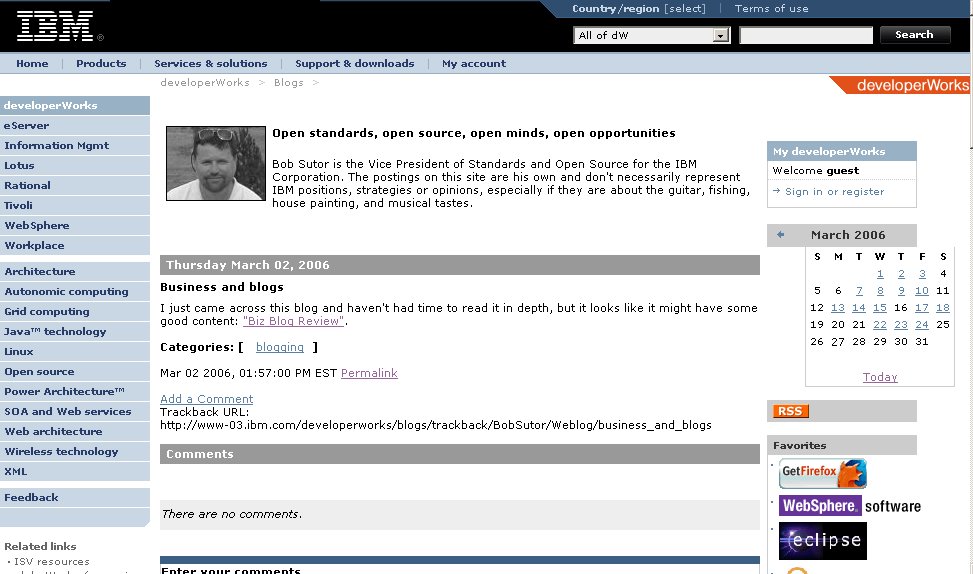
Biz Blog Review recognized by IBM!
(Click on picture to enlarge)
Bob Sutor, Vice President of Standards and Open Source at IBM, mentions Biz Blog Review on his site:
http://www-03.ibm.com/developerworks/blogs/
page/BobSutor?entry=business_and_blogs
http://www.sutor.com/newsite/blog-open/?p=246
"I just came across this blog and haven't had time to read it in depth, but it looks like it might have some good content: "Biz Blog Review", says Bob Sutor.
Thank you, Bob! I look forward to your inputs on this blog and what you think constitutes an effective corporate blog.
Subscribe to:
Posts (Atom)



