In past posts, I've discussed social media in light of standards and corporate responsibility. I received views from various parties, such as USC's Center for Telecom Management, PwC, and others.
Then I posted a link to IBM's reports on "Navigating the Media Divide."
As business and "social media" and forms of marketing evolve...we do see the need for standards and business models that incorporate standards. But how do you approach this from an international standpoint?
For example, iMediaConnection UK published the article, "Crossing the pond with your search engine marketing strategy", where Warren Cowan -- CEO of Greenlight -- refers to the need for cultural knowledge and domain knowledge to avoid not only case study-type marketing disasters but also for translating search campaigns to multi-country campaigns. But what does this mean in terms of standards and corporate responsibility?
Translation of words in meaning may have ethical but not legal liability, or vice versa or both. In using and interpreting "search data", what's the implication? Cowan refers to differences in quality and 'competitiveness of the term' and the impact on pay-per-click. What are the implications beyond pay-per-click ie. the use of this data? Cowan also describes the difference in rankings of international search engines and the need for strong multilingual and culturally fluent talent for site creation in non-domestic English-speaking regions.
The above example is from a marketer's perspective, but what about the impact on the user ie. the companies that go on to use the data obtained from search to develop user experiences or engage with users...?
Here's another example: a software company may produce a package for virtual meetings. Within this software is the capability for the "presenter" to hand over "remote access" to any member within the audience. Depending on the "presenter's" training/view of international relations...they may opt to give remote access to someone in say Burma. Now this Burmese audience member takes control over the presenter's computer to illustrate something within the presentation....However, the potential is there for the Burmese participant to have access to Internet websites that they otherwise wouldn't be allowed to or would be banned from usually in Burma. Potentially, the "presenter" could place the company, and even the country, and not to mention the Burmese, in a position of liability...why? Because a software was produced for sale with a remote function that technically "gets around" certain restrictive international "laws". And this software may have been developed based on "search data".
On another scale, we have privacy issues, such as a Facebook feature that shares what you automatically buy online without requesting consent to do so.
Marketers are developing strategies to "Get personal with your landing pages" -- to reach out to users on a more social and personal level. Although marketers should work to improve strategies, and all of us to improves products and services, we need to do so in a responsible manner.
PwC have produced two reports with US and International Perspective on the Rise of Lifestyle Media.
If standards are to be set for the multi-level use of social media,
1. Who should take the lead and who should be involved in developing these standards?
2. What should the business model look like that incorporates these standards?
3. How should standards be considered internationally?
Showing posts with label Responsibility. Show all posts
Showing posts with label Responsibility. Show all posts
Sunday, November 25, 2007


The Facebook Privacy Issue...
| Name: | Petition: Facebook, stop invading my privacy! |
| Type: | |
| Description: | . . . . . . . . . . (CNN did a story on this group! See below.) Matt in New York already knows what his girlfriend got him for Christmas... Why? Because a new Facebook feature automatically shares books, movies, or gifts you buy online with everyone you know on Facebook. Without your consent, it pops up in your News Feed--a huge invasion of privacy. (See demo below.) CAN YOU SIGN THE PETITION TO FACEBOOK TODAY? THEN INVITE FRIENDS TO THIS GROUP! Petition: "Facebook must respect my privacy. They should not tell my friends what I buy on other sites—or let companies use my name to endorse their products—without my explicit permission." Sign here: http://civ.moveon.org/face Then, tell your friends about this group. A lot of us love Facebook—but they need to take privacy seriously. Facebook encourages companies to get "word-of-mouth promotion for your business" to "millions" by using the new Beacon feature that makes this happen. But the rights of Facebook users get left behind. Facebook says its users can "opt out" of having their private purchases reported to all their friends. But that option is easily missed. And even if you do "opt out" for purchases on one site, it doesn't apply to purchases on another site—you have to keep opting out over and over again. The obvious solution is to switch to an "opt in" policy, like most other applications on Facebook. In 2006, when Facebook users protested policies that violated privacy, Facebook's founder admitted, "We really messed this one up...we didn't build in the proper privacy controls right away." The problem got fixed. (Link below.) SEND A SIGNAL TO FACEBOOK TODAY BY SIGNING THE PETITION! Then tell your friends about this group. The petition is here: http://civ.moveon.org/face |
Tuesday, October 02, 2007
Yahoo!'s Mash getting the Bash?
They're not the only one - "The Assumptions That Yahoo Mash And Other Social Networks Make About You."
Thursday, September 20, 2007
Death of Privacy by Social Media?
iMedia Connection Inc. have published an intriguing article today on the "Death of Privacy" due to Social Media:
Amelia Torode (Head of Digital Strategy VCCP) asks: "As individuals, the web has offered us so many opportunities to connect. We share everything, all the time, with everyone. But where is it all going?"
Torode refers to Emily Nussbaum's New Yorker publication "Say Everything" on teenage online behavior representing the greatest generation gap since rock-n-roll and suggests we read it.
BUT WHERE IS IT ALL GOING?
Nussbaum says: "The future belongs to the uninhibited."
Concluding paragraph:
"The benefits are obvious: The public life is fun. It’s creative. It’s where their friends are. It’s theater, but it’s also community: In this linked, logged world, you have a place to think out loud and be listened to, to meet strangers and go deeper with friends. And, yes, there are all sorts of crappy side effects: the passive-aggressive drama (“you know who you are!”), the shaming outbursts, the chill a person can feel in cyberspace on a particularly bad day. There are lousy side effects of most social changes (see feminism, democracy, the creation of the interstate highway system). But the real question is, as with any revolution, which side are you on?"
Torode says: "I think that by the end of this year we will move away from this era of radical transparency to one of refined privacy. Maybe we will find again that antiquated notion that sometimes silence is golden?"
Concluding paragraph:
Amelia Torode (Head of Digital Strategy VCCP) asks: "As individuals, the web has offered us so many opportunities to connect. We share everything, all the time, with everyone. But where is it all going?"
Torode refers to Emily Nussbaum's New Yorker publication "Say Everything" on teenage online behavior representing the greatest generation gap since rock-n-roll and suggests we read it.
BUT WHERE IS IT ALL GOING?
Nussbaum says: "The future belongs to the uninhibited."
Concluding paragraph:
"The benefits are obvious: The public life is fun. It’s creative. It’s where their friends are. It’s theater, but it’s also community: In this linked, logged world, you have a place to think out loud and be listened to, to meet strangers and go deeper with friends. And, yes, there are all sorts of crappy side effects: the passive-aggressive drama (“you know who you are!”), the shaming outbursts, the chill a person can feel in cyberspace on a particularly bad day. There are lousy side effects of most social changes (see feminism, democracy, the creation of the interstate highway system). But the real question is, as with any revolution, which side are you on?"
----------------------------------------------
Torode says: "I think that by the end of this year we will move away from this era of radical transparency to one of refined privacy. Maybe we will find again that antiquated notion that sometimes silence is golden?"
Concluding paragraph:
"It is fine for us grown-ups to know that we have to manage our own personal "brand," but much harder (if not impossible) for a teenager to realise that everything we do online has tracks, and this indeed is a scary thought. I wonder whether something like Ning and other micro-social networks are the way forward. Ning allows you to create your own bespoke network of "friends" based around specific passion points, so in my Ning account group I would not dream of posting pictures from my hen night, because I communicate about the professional world that I inhabit."
----------------------------------------------
I found both these conclusions thoughtful.
- Who promotes the death of privacy through social or online media?
- What are teenagers facing today that companies, schools, and families, do differently with use of online or social media and how does this impact on their sense of privacy?
- How are adults responding to social media and the "death of privacy"?
- Social media gives audiences across the board a voice - how does this impact not just individuals but entities?
Sunday, September 16, 2007
BlogCasts vs Podcasts
 Shockpod have had this post up on Google for ages with my email address causing my gmail account to be spammed.
Here's the idea:
BlogCasts vs. Podcasts...?
BlogCasts vs. Podcasts...?
BlogCasts are something to consider. One of my thoughts are being able to have blog posts with audio or voice-over which can be heard while typed and/or read on screen...that may be coming soon in the future (nothing is impossible). And it may help and be fun for people with and without challenges who use these technologies/media.
Imagine having blog posts read to you while you're busy doing something? Imagine a cooking blog with recipes and pictures. Yes - you could use your iPod - and there is YouTube videos and such inserted in blogs with sound. But, you could have your Apple iBook, IBM / Lenovo Thinkpad, or HP Notebook plugged in with the voice over of Dolly Parton telling you how to cook that Turkey from your favorite blog posts! What if you could choose the voice-over just to put you in specific mood too? Wouldn't that be neat?!
On Dec 31, 2006, I wrote a short entry titled "BlogCasts" on this blog - http://bizblogreview.blogspot.com/2006/01/blogcasts.html, related to having podcast interviews with executives available on my site as "BlogCasts". However, I changed my mind about doing this for that period. I thought "BlogCasts" could in the future develop into something far greater, even if I'm not the developer or the producer.
Friday, September 14, 2007
Cadbury's Drum Up African Spirit in Rugby World Cup '07!
See Video: http://bizrapport.blogspot.com/2007/09/sa-vs-uk-2007-world-cup-highlights.html
The advertisement was shown just before the start of the England vs. South Africa Rugby World Cup 2007. After South Africa thumped England 36-0, I wondered about this ad...the connections advertisements make in the mind...and the timing of an advertisement's broadcast.
For different viewers, what connections would their minds make when watching this advertisement?
If the advertisement was shown at half-time with score around 20-0 or towards the end, what connections would the mind make then (some players were injured with blood running down their faces)?
The first connection my mind made when I saw this advertisement was "Gorillas in the Mist" - the film that depicts the true-life story of Dian Fossey who fought to protect Gorillas from poaching and extinction in Rwanda: http://en.wikipedia.org/wiki/Gorillas_in_the_Mist:_The_Story_of_Dian_Fossey
True, there is the "choclate-sex connection" because of Phil Collins's song "Coming in the air tonight..." and enthusiasm with humor, but after the game when the mind still connects - what other connections may be made?
"Cadbury's Drum Up African Spirit"
The English continent isn't the natural "home" to Gorillas, it's the forests of Africa, although through colonization they inhabited English territory. Were Cadbury's supporting S. Africa?
Advertisements carry conscious and sub-conscious messages. Depending on demographics and the likely connections minds may make where those ads are broadcast, combined with the timing of events at the time of broadcast, the impact on the product or service can be quite far-reaching.
If simply downloaded from YouTube or watched on my blog and not in the context of the World Cup, it may send a different message too.
Gorilla DNA is 97-98% identical to that of a human - http://en.wikipedia.org/wiki/Gorillas
Why do we as humans respond differently to a Gorilla playing a set of drums in this ad than a human?
These are interesting dynamics to consider.
The advertisement was shown just before the start of the England vs. South Africa Rugby World Cup 2007. After South Africa thumped England 36-0, I wondered about this ad...the connections advertisements make in the mind...and the timing of an advertisement's broadcast.
For different viewers, what connections would their minds make when watching this advertisement?
If the advertisement was shown at half-time with score around 20-0 or towards the end, what connections would the mind make then (some players were injured with blood running down their faces)?
The first connection my mind made when I saw this advertisement was "Gorillas in the Mist" - the film that depicts the true-life story of Dian Fossey who fought to protect Gorillas from poaching and extinction in Rwanda: http://en.wikipedia.org/wiki/Gorillas_in_the_Mist:_The_Story_of_Dian_Fossey
True, there is the "choclate-sex connection" because of Phil Collins's song "Coming in the air tonight..." and enthusiasm with humor, but after the game when the mind still connects - what other connections may be made?
"Cadbury's Drum Up African Spirit"
The English continent isn't the natural "home" to Gorillas, it's the forests of Africa, although through colonization they inhabited English territory. Were Cadbury's supporting S. Africa?
Advertisements carry conscious and sub-conscious messages. Depending on demographics and the likely connections minds may make where those ads are broadcast, combined with the timing of events at the time of broadcast, the impact on the product or service can be quite far-reaching.
If simply downloaded from YouTube or watched on my blog and not in the context of the World Cup, it may send a different message too.
Gorilla DNA is 97-98% identical to that of a human - http://en.wikipedia.org/wiki/Gorillas
Why do we as humans respond differently to a Gorilla playing a set of drums in this ad than a human?
These are interesting dynamics to consider.
blackpig on innovation and the marketing balance
I've asked the blackpig team (http://www.blackpig.co.uk/) on their blog how companies should go about (solutions) achieving a balance when using a standard product/service while engaging in innovations, trying to achieve a competitive and sustainable advantage, and meeting responsibilities.
I found this post on the blackpig site quite interesting:
"Edward De Bono is often regarded as the father of lateral thinking in creative circles and has numerous tips and techniques which can easily be incorporated into any marketing planning session to produce some truly innovative results. One of the simplest is the PMI (Plus, Minus & Interesting).
With the PMI you don’t just produce a list of pro’s and con’s of an idea you also list interesting results too, for example if a business was to start giving bonus’ for staff who went a year without taking a sick day some of the ‘pro’s’ might be: motivating staff to work harder and bonuses would cover lost sick time pay. ‘Con’s’: might be that staff who are genuinely too ill to come to work become disgruntled. And the ‘interesting’: because staff force themselves to work whilst ill could it result in more sickness around the company?
Another relatively easy technique to encourage creative thinking and innovation is backwards brainstorming; in this you produce a list of points which would have the opposite effect of what you want, for example a business producing a new website may have points including being viewable in only one specific browser, not updating the content, having large images and making it difficult to navigate. From this list you then turn each point around to create a list of solutions."
Source: http://www.blackpig.co.uk/wordpress/?p=53
--------------------------
I found this post on the blackpig site quite interesting:
"Edward De Bono is often regarded as the father of lateral thinking in creative circles and has numerous tips and techniques which can easily be incorporated into any marketing planning session to produce some truly innovative results. One of the simplest is the PMI (Plus, Minus & Interesting).
With the PMI you don’t just produce a list of pro’s and con’s of an idea you also list interesting results too, for example if a business was to start giving bonus’ for staff who went a year without taking a sick day some of the ‘pro’s’ might be: motivating staff to work harder and bonuses would cover lost sick time pay. ‘Con’s’: might be that staff who are genuinely too ill to come to work become disgruntled. And the ‘interesting’: because staff force themselves to work whilst ill could it result in more sickness around the company?
Another relatively easy technique to encourage creative thinking and innovation is backwards brainstorming; in this you produce a list of points which would have the opposite effect of what you want, for example a business producing a new website may have points including being viewable in only one specific browser, not updating the content, having large images and making it difficult to navigate. From this list you then turn each point around to create a list of solutions."
Source: http://www.blackpig.co.uk/wordpress/?p=53
Wednesday, September 12, 2007
David Maister's blog on "How Much Standardization?"
There's a great discussion on David Maister's blog about "How Much Standardization?" - take a look - http://davidmaister.com/blog/481/How-Much-Standardization.
Tuesday, September 11, 2007
RFID Memo to the CEO
Back in 2004, we were given a memo assignment in my Advanced Business Writing class (one of my first at USC) on the topic of "trickle-down effects in business" - a subject of our choice. We had to address this memo to our professor as if she was the CEO. The use of RFID has come a long way since this memo I wrote then (it may appear a bit distorted because of the blog-tool):
To: Yolanda Kirk, CEO
From: Fiona Torrance
Subject: Trickle-down Effects of RFID Technology
Date: September 16, 2004
We recently discussed the future of the barcode, and as we both agreed that it wasn't the most efficient technology in terms of inventory tracking and cost used by retail companies like our own, I decided to research its successor – Radio Frequency Identification (RFID) technology.
This analysis with provide you with the following:
· industries experiencing the trickle-down effects of RFID
· origin of RFID and how it works
· RFID's benefit to the retail industry
RFID application is not limited to any particular industry. It has multiple effects on businesses and consumers. The retail industry have recognized the impact of RFID use, and are pioneering its advancement. The web site, internetnews.com, had an interesting write-up titled, “Are You Ready for RFID?” by Colin C. Haley. In discussing this trend, he says, “Retailers believe RFID will replace bar codes, vastly improve the efficiency of their supply chain and cut down on theft and loss.
Still other business sectors are looking at tags and readers for a variety of tasks” (Haley 1). Business sectors are considering the advantages of implementing RFID and the trickle-down effects RFID is having on other industries, and on individuals.
Industries Experiencing Trickle-down Effects of RFID Besides the retail industry, RFID technology is revolutionizing many other industries and organizations, some of those experiencing the trickle-down effects of RFID include:
· Engineering and Information Technology
· Educational Institutes, Library Services, and Publishers
· National and International Security
· Public Services
· Agriculture, Botany, and Zoology
· Health and Medical
· Food and Beverage
· Legal, Accounting, and Financial
· Retail and Manufacturing
Recently, RFID technology has been embedded in bandages to monitor wounds and to monitor SARS patients in China. It is also being used in refrigerators to detect spoiled food. Research in all fields greatly benefits from RFID development. RFID technology has the potential to alter the operations of almost every industry that you can think of, and to change the way that businesses and individuals interact.
The technology is becoming much less costly to produce, ranging from 10¢ to $1 per RFID tag depending on the particular type of RFID required – read-only, write-only, or both. You can think of RFID technology as a database with programmable capabilities. I'll now give you some background of RFID's origins and how it works.
The Origin of RFID
RFID technology was previously used during the 1940’s in World War II military aircraft to detect friend from foe. Mainly being used by the military for detection and tracking, its other uses for many years did not venture much further than air traffic control and vehicle monitoring at tollgates. But RFID is now being developed by engineering firms world-wide for multi-use in industries and organizations. Scientists have drawn an analogy between the development of the Internet - and its global impact - and RFID development.
Debora Vrana recently featured an article in the L.A. Times about the Pasadena-based company, Avery Dennison Corp., and their use of RFID in labels. She quotes the editor of the RFID Journal, Mark Roberti, as saying, “This is a lot like what the Internet was in 1995, we are on the verge of a major change in the way companies do business” (qtd. in Vrana C1). With this change comes many ramifications because of how RFID works, so I've provided you with a brief description below.
How RFID Works
RFID is a transponder that allows identification of radio frequency. This transponder contains programmable electronic code, embedded with a unique identification number. It is often referred to as an ‘RFID tag’. A receiver, containing an antenna, detects the tag within its electromagnetic field, and is able to wirelessly receive and transmit information to and from the tag.
The RFID tag can be as small as a pin-head and can share information about any object, animal, or person that it is attached to. It acts as a tracking device and a portable database that allows multiple tags to be read simultaneously. RFID tags survive harsh climatic conditions and hazardous environments. Because of its features and versatile use, the RFID tag is deemed to replace the barcode and smartcard in the future, and to revolutionize industries and organizations globally.
The retail industry is at the head of this revolution with its implementation of RFID. Retail companies, like our own, have to make a decision about whether or not to embrace this change. It's not an easy decision to make without the knowledge of how we will be affected, and what measures will need to be in place to facilitate RFID use. This information on RFID's benefit to the retail industry may give us a starting point for further discussion.
RFID Benefits the Retail Industry
Retailers and manufacturers stand to benefit from RFID in the following three main areas:
· Financing Activities
· Operating Activities
· Investing Activities
The effect on each activity is briefly discussed below, starting with financing activities.
Financing Activities
Retail financing activities involve the exchange of resources between owners for a return, or gaining resources from creditors for future settlement. Retailers are experiencing an effect on their financing activities due to RFID in some of the following ways:
1. Improved tracking of resources due to RFID's accurate monitoring abilities
2. Substantial reduction in shrinkage costs as RFID enhances security
3. More efficient business forecasting because of the quality of data transmitted by RFID
Intel list the values of RFID in the Business/Enterprise section of their Homepage stating: “RFID reader-generated data can be converted into valuable, actionable information that delivers a significant return on investment by capturing, consolidating, and analyzing huge volumes of data which can be used to make faster and better business decisions” (Intel 1).
RFID provides the information that businesses need to make more efficient calculations of future earnings. Its tracking abilities also reduces the cost of shrinkage and theft, as operations are streamlined.
Operating Activities
Running a retail and manufacture business involves daily activities where RFID is playing a major role. Some of these business operational activities include:
1. Improved system for purchase and sale of inventory as recorded data is accurate and immediately available
2. Efficient management of the supply chain, reducing labor costs and human error
3. Better customer service in terms of monitoring of stock, defective goods, and delivery
Prashant Bhatia and Greg Gilbert, writing for the E-Business Executive Daily, highlight the effects of RFID on the supply chain and customer service, saying, “The rippling effects of RFID will permeate across many industries enabling a new level of customer service and nimbleness in the supply chain.
Instead of looking to the industry to dictate what RFID can do for them; leading businesses will gain recognition for what they have done with RFID” (Bhatia and Gilbert 2). Their view is that how businesses use RFID will be what redefines their position and influence in the business sector. The retail supply chain is expected to invest from $91.5 million in 2003 to nearly $1.3 billion in 2008 on RFID technology (Earls 1).
Investing Activities
Retail and manufacturing firms try to spend capital productively in line with company objectives. RFID is viewed as a key contributor in making some of these investing activities successful:
1. The replacement of long-term assets to facilitate RFID use will become more economical as RFID's costs reduce, and because of RFID's long-term durability
2. Cash availability for investment in marketable securities will increase because of these cost-savings
3. Changing company objectives to meet the capabilities of RFID will enable positioning and influence within the business sector, and will spur industry growth
Investing in RFID technology carries with it risks and rewards, William Atkinson discusses these in the Risk Management publication. In his analysis, he quotes the principal of Stamford, Gartner, Inc., Jeff Woods, as saying, “RFID represents huge investment in new IT.
Wal-Mart, for example, is expected to be investing a couple of billion of dollars in equipment alone. As such, one implication for risk management is the tremendous shift in a company’s data collection budget from labor to assets” (qtd. in Atkinson 3). Moving the company’s data collection budget from labor to assets is an example of the risk Wal-Mart is taking by investing its capital in RFID-compatible equipment.
There is no doubt that the implementation of RFID will boost the activities of industries, such as the retail and manufacture industries, however, the advent of RFID and its infancy is not without its concerns. And, these concerns seriously affect all industries mentioned and not mentioned in this document. I've listed some of these concerns for you to consider.
Concerns about RFID
There are arguments both in favor and against RFID advancement with respect to the following important issues:
· No current standardization of RFID technology exists
· Regulation of RFID capabilities, and international use, is still to be determined
· Royalties on RFID designs are a grey area that could increase trickle-down costs
· Public reaction to RFID use and its capabilities, particularly when in the wrong hands,
is pending because of the lack of awareness about the technology
· The need to protect personal privacy could be costly
All these concerns are valid and could intensely weigh the benefits down if RFID is implemented prematurely, or too late causing loss of competitiveness and industry position. We would need to balance these interests and the decisions we make to protect us from both possibilities.
Weighing the Interests of RFID
The ‘birth’ of the internet sparked debate about its origin, features, and uses, yet it is still evolving even with jurisdiction and security issues within the United States. Similarly, the mandates by Wal-Mart Stores Inc. and the Department of Defense (DoD) which force suppliers to adopt the new RFID technology starting January 1, 2005, are igniting awareness and discussion amongst industries, organizations, and individuals.
The far-reaching ramifications created by the ‘birth’ of RFID is yet to be experienced and identified as it evolves and changes how we do business, or how we conduct our lives. Although, in the retail industry specifically, we foresee substantial benefits to our financing, operating, and investing activities if we embrace RFID, the concerns raised about standardization, regulation, and privacy will have to be addressed.
We will have to consider the restructuring process within our company accordingly, and this is why I have provided you with this overview of RFID technology. Should you have any questions or details that you would like me to research more in-depth, let me know and I'll do so with pleasure.
Works Cited
Atkinson, William. “Tagged: The Risks and Rewards of RFID Technology.” Risk Management 51.7 (2004) : 12-19. Proquest. Business. USC Lib., Los Angeles, CA. 5 September 2004 http://www.proquest.com/
Bhatia, Prashant, and Greg Gilbert. “Now’s the Time for RFID”. Line56.com: The E- Business Executive Daily 22 April 2003. Google. 12 September 2003 http://www.line56.com/
Earls, Alan R. “Are You Ready for RFID?” The Know Retail Management 2004. Google. 9 September 2004 http://www.theknow.net/
Haley, Colin C. “Are You Ready for RFID?” Internetnews.com 14 November 2003. Google. 12 September 2004 http://boston.internet.com/news/article.php/3109501
Intel Homepage. “Rfid Converts Data into Business Value.” Business/Enterprise. 2004. Google. 12 September 2004 http://www.intel.com/
Richardson, Helen L. “Tuning in to RFID.” World Trade Magazine 1 November 2003. Google. 10 January 2004 http://www.worldtrademag.com/
Roberti, Mark. “The RFID “Revolution”.” RFID Journal 12 January 2004. Google. 10 January 2004 http://www.rfidjournal.com/
Vrana, Deborah. “Avery Dennison Is Hoping New Technology for Its Labels Will Stick.” L.A. Times 29 August 2004, Business: C1
To: Yolanda Kirk, CEO
From: Fiona Torrance
Subject: Trickle-down Effects of RFID Technology
Date: September 16, 2004
We recently discussed the future of the barcode, and as we both agreed that it wasn't the most efficient technology in terms of inventory tracking and cost used by retail companies like our own, I decided to research its successor – Radio Frequency Identification (RFID) technology.
This analysis with provide you with the following:
· industries experiencing the trickle-down effects of RFID
· origin of RFID and how it works
· RFID's benefit to the retail industry
RFID application is not limited to any particular industry. It has multiple effects on businesses and consumers. The retail industry have recognized the impact of RFID use, and are pioneering its advancement. The web site, internetnews.com, had an interesting write-up titled, “Are You Ready for RFID?” by Colin C. Haley. In discussing this trend, he says, “Retailers believe RFID will replace bar codes, vastly improve the efficiency of their supply chain and cut down on theft and loss.
Still other business sectors are looking at tags and readers for a variety of tasks” (Haley 1). Business sectors are considering the advantages of implementing RFID and the trickle-down effects RFID is having on other industries, and on individuals.
Industries Experiencing Trickle-down Effects of RFID Besides the retail industry, RFID technology is revolutionizing many other industries and organizations, some of those experiencing the trickle-down effects of RFID include:
· Engineering and Information Technology
· Educational Institutes, Library Services, and Publishers
· National and International Security
· Public Services
· Agriculture, Botany, and Zoology
· Health and Medical
· Food and Beverage
· Legal, Accounting, and Financial
· Retail and Manufacturing
Recently, RFID technology has been embedded in bandages to monitor wounds and to monitor SARS patients in China. It is also being used in refrigerators to detect spoiled food. Research in all fields greatly benefits from RFID development. RFID technology has the potential to alter the operations of almost every industry that you can think of, and to change the way that businesses and individuals interact.
The technology is becoming much less costly to produce, ranging from 10¢ to $1 per RFID tag depending on the particular type of RFID required – read-only, write-only, or both. You can think of RFID technology as a database with programmable capabilities. I'll now give you some background of RFID's origins and how it works.
The Origin of RFID
RFID technology was previously used during the 1940’s in World War II military aircraft to detect friend from foe. Mainly being used by the military for detection and tracking, its other uses for many years did not venture much further than air traffic control and vehicle monitoring at tollgates. But RFID is now being developed by engineering firms world-wide for multi-use in industries and organizations. Scientists have drawn an analogy between the development of the Internet - and its global impact - and RFID development.
Debora Vrana recently featured an article in the L.A. Times about the Pasadena-based company, Avery Dennison Corp., and their use of RFID in labels. She quotes the editor of the RFID Journal, Mark Roberti, as saying, “This is a lot like what the Internet was in 1995, we are on the verge of a major change in the way companies do business” (qtd. in Vrana C1). With this change comes many ramifications because of how RFID works, so I've provided you with a brief description below.
How RFID Works
RFID is a transponder that allows identification of radio frequency. This transponder contains programmable electronic code, embedded with a unique identification number. It is often referred to as an ‘RFID tag’. A receiver, containing an antenna, detects the tag within its electromagnetic field, and is able to wirelessly receive and transmit information to and from the tag.
The RFID tag can be as small as a pin-head and can share information about any object, animal, or person that it is attached to. It acts as a tracking device and a portable database that allows multiple tags to be read simultaneously. RFID tags survive harsh climatic conditions and hazardous environments. Because of its features and versatile use, the RFID tag is deemed to replace the barcode and smartcard in the future, and to revolutionize industries and organizations globally.
The retail industry is at the head of this revolution with its implementation of RFID. Retail companies, like our own, have to make a decision about whether or not to embrace this change. It's not an easy decision to make without the knowledge of how we will be affected, and what measures will need to be in place to facilitate RFID use. This information on RFID's benefit to the retail industry may give us a starting point for further discussion.
RFID Benefits the Retail Industry
Retailers and manufacturers stand to benefit from RFID in the following three main areas:
· Financing Activities
· Operating Activities
· Investing Activities
The effect on each activity is briefly discussed below, starting with financing activities.
Financing Activities
Retail financing activities involve the exchange of resources between owners for a return, or gaining resources from creditors for future settlement. Retailers are experiencing an effect on their financing activities due to RFID in some of the following ways:
1. Improved tracking of resources due to RFID's accurate monitoring abilities
2. Substantial reduction in shrinkage costs as RFID enhances security
3. More efficient business forecasting because of the quality of data transmitted by RFID
Intel list the values of RFID in the Business/Enterprise section of their Homepage stating: “RFID reader-generated data can be converted into valuable, actionable information that delivers a significant return on investment by capturing, consolidating, and analyzing huge volumes of data which can be used to make faster and better business decisions” (Intel 1).
RFID provides the information that businesses need to make more efficient calculations of future earnings. Its tracking abilities also reduces the cost of shrinkage and theft, as operations are streamlined.
Operating Activities
Running a retail and manufacture business involves daily activities where RFID is playing a major role. Some of these business operational activities include:
1. Improved system for purchase and sale of inventory as recorded data is accurate and immediately available
2. Efficient management of the supply chain, reducing labor costs and human error
3. Better customer service in terms of monitoring of stock, defective goods, and delivery
Prashant Bhatia and Greg Gilbert, writing for the E-Business Executive Daily, highlight the effects of RFID on the supply chain and customer service, saying, “The rippling effects of RFID will permeate across many industries enabling a new level of customer service and nimbleness in the supply chain.
Instead of looking to the industry to dictate what RFID can do for them; leading businesses will gain recognition for what they have done with RFID” (Bhatia and Gilbert 2). Their view is that how businesses use RFID will be what redefines their position and influence in the business sector. The retail supply chain is expected to invest from $91.5 million in 2003 to nearly $1.3 billion in 2008 on RFID technology (Earls 1).
Investing Activities
Retail and manufacturing firms try to spend capital productively in line with company objectives. RFID is viewed as a key contributor in making some of these investing activities successful:
1. The replacement of long-term assets to facilitate RFID use will become more economical as RFID's costs reduce, and because of RFID's long-term durability
2. Cash availability for investment in marketable securities will increase because of these cost-savings
3. Changing company objectives to meet the capabilities of RFID will enable positioning and influence within the business sector, and will spur industry growth
Investing in RFID technology carries with it risks and rewards, William Atkinson discusses these in the Risk Management publication. In his analysis, he quotes the principal of Stamford, Gartner, Inc., Jeff Woods, as saying, “RFID represents huge investment in new IT.
Wal-Mart, for example, is expected to be investing a couple of billion of dollars in equipment alone. As such, one implication for risk management is the tremendous shift in a company’s data collection budget from labor to assets” (qtd. in Atkinson 3). Moving the company’s data collection budget from labor to assets is an example of the risk Wal-Mart is taking by investing its capital in RFID-compatible equipment.
There is no doubt that the implementation of RFID will boost the activities of industries, such as the retail and manufacture industries, however, the advent of RFID and its infancy is not without its concerns. And, these concerns seriously affect all industries mentioned and not mentioned in this document. I've listed some of these concerns for you to consider.
Concerns about RFID
There are arguments both in favor and against RFID advancement with respect to the following important issues:
· No current standardization of RFID technology exists
· Regulation of RFID capabilities, and international use, is still to be determined
· Royalties on RFID designs are a grey area that could increase trickle-down costs
· Public reaction to RFID use and its capabilities, particularly when in the wrong hands,
is pending because of the lack of awareness about the technology
· The need to protect personal privacy could be costly
All these concerns are valid and could intensely weigh the benefits down if RFID is implemented prematurely, or too late causing loss of competitiveness and industry position. We would need to balance these interests and the decisions we make to protect us from both possibilities.
Weighing the Interests of RFID
The ‘birth’ of the internet sparked debate about its origin, features, and uses, yet it is still evolving even with jurisdiction and security issues within the United States. Similarly, the mandates by Wal-Mart Stores Inc. and the Department of Defense (DoD) which force suppliers to adopt the new RFID technology starting January 1, 2005, are igniting awareness and discussion amongst industries, organizations, and individuals.
The far-reaching ramifications created by the ‘birth’ of RFID is yet to be experienced and identified as it evolves and changes how we do business, or how we conduct our lives. Although, in the retail industry specifically, we foresee substantial benefits to our financing, operating, and investing activities if we embrace RFID, the concerns raised about standardization, regulation, and privacy will have to be addressed.
We will have to consider the restructuring process within our company accordingly, and this is why I have provided you with this overview of RFID technology. Should you have any questions or details that you would like me to research more in-depth, let me know and I'll do so with pleasure.
Works Cited
Atkinson, William. “Tagged: The Risks and Rewards of RFID Technology.” Risk Management 51.7 (2004) : 12-19. Proquest. Business. USC Lib., Los Angeles, CA. 5 September 2004 http://www.proquest.com/
Bhatia, Prashant, and Greg Gilbert. “Now’s the Time for RFID”. Line56.com: The E- Business Executive Daily 22 April 2003. Google. 12 September 2003 http://www.line56.com/
Earls, Alan R. “Are You Ready for RFID?” The Know Retail Management 2004. Google. 9 September 2004 http://www.theknow.net/
Haley, Colin C. “Are You Ready for RFID?” Internetnews.com 14 November 2003. Google. 12 September 2004 http://boston.internet.com/news/article.php/3109501
Intel Homepage. “Rfid Converts Data into Business Value.” Business/Enterprise. 2004. Google. 12 September 2004 http://www.intel.com/
Richardson, Helen L. “Tuning in to RFID.” World Trade Magazine 1 November 2003. Google. 10 January 2004 http://www.worldtrademag.com/
Roberti, Mark. “The RFID “Revolution”.” RFID Journal 12 January 2004. Google. 10 January 2004 http://www.rfidjournal.com/
Vrana, Deborah. “Avery Dennison Is Hoping New Technology for Its Labels Will Stick.” L.A. Times 29 August 2004, Business: C1
Tuesday, September 04, 2007
Brainy Brands, Emotions, and Eve's Apple - Brain Patterns - Useful in Social Media Search?
Yesterday, I went to Brighton. While travelling back on Southwestern Rail, a pretty young lady with long fair hair sat opposite me in the coach.
My eyes fixated on her adam's (or should we call it eve's?) apple - it was wobbling up and down. I thought: "This young lady's about to cry." Then I thought: "Don't make assumptions, look at her eyes...look for other signs." The eyes were slightly watery. But that didn't necessarily mean emotional tears.
Suddenly all I saw was a giant ONION. Dad's Army? Dixondale Farms? David Coleman? An onion on a billboard that said: "We know our onions..." The billboard was attached to some scaffolding as I passed on a bus between Tower Hill and Victoria earlier that day.
The brain's ability to associate tears with onions and attach memory is amazing. This is another area to explore. People's brains must create different patterns when connecting emotions, perceptions and memory. Those patterns may be used in social media search. Marketers have all kinds of avenues to experiment with especially with the development of biometrics and tools like fMRI.
Too far off? Look at Case 7 and 11 - http://ethics.iit.edu/eb/Nationalcases20071.pdf.
But ethics (simply a custom or habit - your thinking and doing) do have to be considered when marketing products and appealing to emotions because of social and moral responsibility to others. So I'd ask you to think about the contribution of someone like Jean-Jacques Rousseau (1712-1778) - Genevan Philosopher of the Enlightenment and his socialist theory (social media?):
1. Society's negative influence on men centers on its transformation of a positive self-love (what he terms "Amour de soi") into pride or "Amour propre". The self-love is our instinctive human desire to self-preserve combined with our human power of reason.
Pride, on the other hand, is artificial and forces man to compare himself to others. The articiality and comparison creates fear, allowing men to take pleasure in the pain or weakness of others. Rousseau was not the first to make this distinction. The French moralist, Luc de Clapier, marques de Vauvenargues is thought to be the first.
Rousseau viewed society as artificial and held that the development of society, especially the growth of social interdependence, has been inimical to the well-being of human beings. Marketers have to consider the well-being of human beings when developing and deploying metrics, search strategies, and campaigns.
2. Rousseau published "Discourse in the Arts and Sciences" where he "argued that the arts and sciences had not been beneficial to humankind because they were not human needs, but rather a result of pride and vanity" (wikipedia).
He saw both as disciplines that created opportunities for idleness and luxury with the progress of knowledge that contributed to the corruption of man, and the overpowering of goverments that crushed individual liberty.
His conclusion: Material progress undermined the possibility of sincere friendship because it replaced genuineness with jealousy, fear, and suspicion.
3. Another work of Rosseau's is the "Discourse on Inequality" where he argues a number of points:
a) primitive humans were possessed of a basic drive to care for themselves and a natural disposition for compassion and pity
b) humans were forced to associate together more closely by the pressure of population growth, they underwent a psychological transformation and came to value the good opinion of others as an essential component of their own well-being
c) their new self-awareness was associated with a golden age of human flourishing - the development of agriculture, metallurgy, private property... (social contract created by the rich & poweful)
d) humans became increasingly dependent on one another which led to inequality and a state of conflict (the flaw of the social contract)
Conclusion: "...the desire to have value [brand?] in the eyes of others, which originated in the golden age, comes to undermine personal integrity and authenticity in a society marked by interdependence, hierarchy, and inequality" (Wikipedia).
Challenge for Brand Marketers: How do you create a desirable brand that does not undermine personal integrity and authenticity in a society marked by interdependence, hierarchy, and inequality?
In his "Social Contract", Rosseau advocates that individuals free themselves by abondoning their claim on natural right because submission to the authority of the general will of the people protects individuals from the subordinate will of others, and also ensures that they obey themselves because they are, collectively, the authors of the law.
According to the Wikipedia, he invented modern autobiography (isn't blogging a form of autobiography?) - http://en.wikipedia.org/wiki/Jean-Jacques_Rousseau
Lists of Ethicists: http://en.wikipedia.org/wiki/List_of_ethicists
My eyes fixated on her adam's (or should we call it eve's?) apple - it was wobbling up and down. I thought: "This young lady's about to cry." Then I thought: "Don't make assumptions, look at her eyes...look for other signs." The eyes were slightly watery. But that didn't necessarily mean emotional tears.
Suddenly all I saw was a giant ONION. Dad's Army? Dixondale Farms? David Coleman? An onion on a billboard that said: "We know our onions..." The billboard was attached to some scaffolding as I passed on a bus between Tower Hill and Victoria earlier that day.
The brain's ability to associate tears with onions and attach memory is amazing. This is another area to explore. People's brains must create different patterns when connecting emotions, perceptions and memory. Those patterns may be used in social media search. Marketers have all kinds of avenues to experiment with especially with the development of biometrics and tools like fMRI.
Too far off? Look at Case 7 and 11 - http://ethics.iit.edu/eb/Nationalcases20071.pdf.
But ethics (simply a custom or habit - your thinking and doing) do have to be considered when marketing products and appealing to emotions because of social and moral responsibility to others. So I'd ask you to think about the contribution of someone like Jean-Jacques Rousseau (1712-1778) - Genevan Philosopher of the Enlightenment and his socialist theory (social media?):
1. Society's negative influence on men centers on its transformation of a positive self-love (what he terms "Amour de soi") into pride or "Amour propre". The self-love is our instinctive human desire to self-preserve combined with our human power of reason.
Pride, on the other hand, is artificial and forces man to compare himself to others. The articiality and comparison creates fear, allowing men to take pleasure in the pain or weakness of others. Rousseau was not the first to make this distinction. The French moralist, Luc de Clapier, marques de Vauvenargues is thought to be the first.
Rousseau viewed society as artificial and held that the development of society, especially the growth of social interdependence, has been inimical to the well-being of human beings. Marketers have to consider the well-being of human beings when developing and deploying metrics, search strategies, and campaigns.
2. Rousseau published "Discourse in the Arts and Sciences" where he "argued that the arts and sciences had not been beneficial to humankind because they were not human needs, but rather a result of pride and vanity" (wikipedia).
He saw both as disciplines that created opportunities for idleness and luxury with the progress of knowledge that contributed to the corruption of man, and the overpowering of goverments that crushed individual liberty.
His conclusion: Material progress undermined the possibility of sincere friendship because it replaced genuineness with jealousy, fear, and suspicion.
3. Another work of Rosseau's is the "Discourse on Inequality" where he argues a number of points:
a) primitive humans were possessed of a basic drive to care for themselves and a natural disposition for compassion and pity
b) humans were forced to associate together more closely by the pressure of population growth, they underwent a psychological transformation and came to value the good opinion of others as an essential component of their own well-being
c) their new self-awareness was associated with a golden age of human flourishing - the development of agriculture, metallurgy, private property... (social contract created by the rich & poweful)
d) humans became increasingly dependent on one another which led to inequality and a state of conflict (the flaw of the social contract)
Conclusion: "...the desire to have value [brand?] in the eyes of others, which originated in the golden age, comes to undermine personal integrity and authenticity in a society marked by interdependence, hierarchy, and inequality" (Wikipedia).
Challenge for Brand Marketers: How do you create a desirable brand that does not undermine personal integrity and authenticity in a society marked by interdependence, hierarchy, and inequality?
In his "Social Contract", Rosseau advocates that individuals free themselves by abondoning their claim on natural right because submission to the authority of the general will of the people protects individuals from the subordinate will of others, and also ensures that they obey themselves because they are, collectively, the authors of the law.
According to the Wikipedia, he invented modern autobiography (isn't blogging a form of autobiography?) - http://en.wikipedia.org/wiki/Jean-Jacques_Rousseau
Lists of Ethicists: http://en.wikipedia.org/wiki/List_of_ethicists
INTP on Facebook - What does this say to Brand Marketers?
This is what I have written in the About Me section in Facebook: "INTP Meyers Briggs "Preference-Type". It used to be INTJ. Heavens knows what it was before then and what it will become!"
Joking aside, here's a link to the INTP preference-type: http://typelogic.com/intp.html on Typelogic and a Portrait of an INTP: http://www.personalitypage.com/INTP.html. Check this site out: http://www.intp.org/images/intpcrossword.gif. And - let's not forget the Wikipedia: http://en.wikipedia.org/wiki/INTP.
The point being...that if Facebook or MySpace (and other online social communities and such) provide the option for users and customers to identify their personality preference types, the "personalization" may help marketers identify their audience and pitch their brands.
Socio-personal metrics could be developed too for use in the social computing/media context.
Jungian functional preference ordering for INTP:
Dominant: Introverted Thinking
Auxiliary: Extraverted Intuition
Tertiary: Introverted Sensing
Inferior: Extraverted Feeling
Recommended Reading: "Type Talk At Work" - Otto Kroeger, Janet M. Thuesen, Hile Rutledge
www.amazon.com/Type-Talk-Work-Revised-Personality/dp/0440509289
Here's a great site with loads of personality tests to gleam ideas from:
http://similarminds.com/personality_tests.html
Joking aside, here's a link to the INTP preference-type: http://typelogic.com/intp.html on Typelogic and a Portrait of an INTP: http://www.personalitypage.com/INTP.html. Check this site out: http://www.intp.org/images/intpcrossword.gif. And - let's not forget the Wikipedia: http://en.wikipedia.org/wiki/INTP.
The point being...that if Facebook or MySpace (and other online social communities and such) provide the option for users and customers to identify their personality preference types, the "personalization" may help marketers identify their audience and pitch their brands.
Socio-personal metrics could be developed too for use in the social computing/media context.
Jungian functional preference ordering for INTP:
Dominant: Introverted Thinking
Auxiliary: Extraverted Intuition
Tertiary: Introverted Sensing
Inferior: Extraverted Feeling
Recommended Reading: "Type Talk At Work" - Otto Kroeger, Janet M. Thuesen, Hile Rutledge
www.amazon.com/Type-Talk-Work-Revised-Personality/dp/0440509289
Here's a great site with loads of personality tests to gleam ideas from:
http://similarminds.com/personality_tests.html
Monday, April 03, 2006
WSJ Inside View of Corporate Blogs
In today’s WSJ, William Bulkeley makes the statement: “Employee blogs can put a human face on companies. But that’s not always a good thing.”
* Because many corporate image specialists foresee a confusing array of corporate messages – some so sanitized that they lack credibility.
* Because lawyers fear that some employees’ thoughts may provide fodder for plaintiffs’ lawyers or give away company secrets or advice that a company prefers to sell.
Knowing these risks, corporate blogs are growing in number – Why?
Because being left out of the online community by not adopting this ‘burgeoning communications medium’ is a greater risk to business.
Corporate blogs provide the means to:
* Get to know companies (such as GM’s current challenges and changes)
* Contribute to company policy (such as Thomas Nelson who uses suggestions from comments on their company blog)
* Confront controversy (such as Cisco’s response to critics over their equipment used by the Chinese government to censor)
Companies need to establish blogging policies:
Companies and employees blog to communicate, but discretion is involved. With employees fired (“dooced”) for blogging, such as the reporter from Dover Post, companies are including blogging policies within company policy.
A survey of 1,000 employees by Employment Law Alliance found only 15% of companies have blogging policies. Blogging policies are needed to justify the firing of an employee for inappropriate blogging that harms the company.
Companies also need to require bloggers to use their real names because, “Many fear that a blogger who isn’t using his name will still be identifiable as a company employee and attract attention by denigrating rivals, blasting politicians or sneering at the boss”, reports Bulkeley. When bloggers take ownership of their posts it encourages constructive input and accuracy.
The credibility debate continues between top executives that may not seem believable compared with independent bloggers who are free to write their wants.
Companies can preserve credibility by publicly accepting criticism:
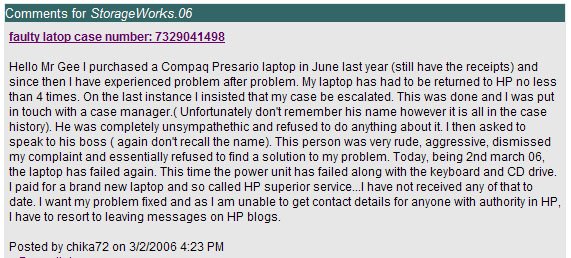
Yesterday, I discovered a great example of published public acceptance of criticism on the Hewlett Packard Executive Blog of Duncan Cambell – Vice President of Marketing, StorageWorks Division: (Click on picture to enlarge)
http://h20325.www2.hp.com/blogs/
Some corporations are open to this strategy to validate individuals who have concerns, and to take action on the criticisms where reasonable and appropriate.
Many companies, such as IBM and HP, expect bloggers to register before leaving comments that removes the “anonymity” issue, guides decent expression, and builds credibility.
In addition, many of companies also moderate the comments before they appear on the corporate blog.
The blogs mentioned in this article are listed in my blogroll for reference.
Monday, March 27, 2006
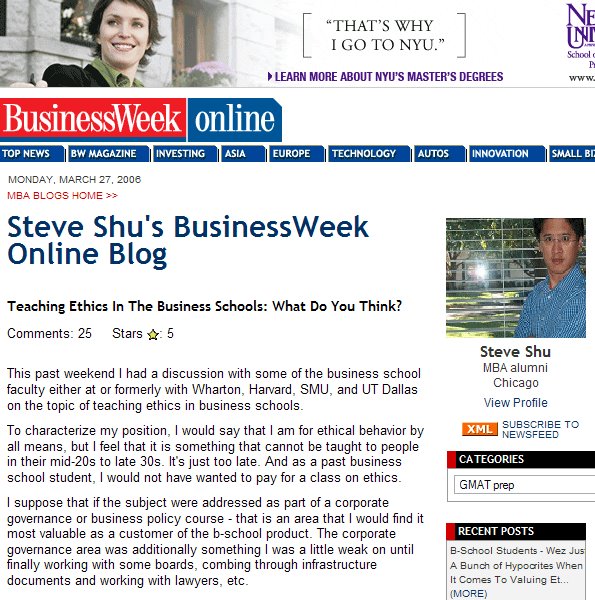
Business Week MBABlog -- "Teaching Ethics in Business Schools"
 (Click to enlarge picture)
To quote Steve Shu:
"But I think in my discussions with the b-school professors, I think the position I hold (which is not so optimistic about teaching ethics in the business schools) is a minority position. The general consensus seemed to be that ethics should be taught more actively in business schools. That leaders need to have such skills" [http://steveshu21pub.mbablogs.businessweek.com
/weblogEntry/1444m0w9utpyc.htm].
Steve's position is that although he is for ethics, he doesn't think people in their mid-20's to late 30's can be taught ethics.
Ethics Cases In Point:
USC's Marshall School of Business, Center for Management Communication, offers an excellent special interest (previously BUAD 499) "Ethics, Independent Research, and Public Communications" class. Students (in their mid-20's to 30's) actually partake in real-life ethics cases to learn how to recognize specific ethical dilemmas and to seek solutions to these real-life ethical problems.
My response to you, Steve, is that irrespective of age, it depends on what is important and of interest to you.
Although ethics is debatable in perspective, business students can and should learn strategies to identify and deal with ethical issues in the workplace.
If employees (post-undergraduate and post-graduate) face ethical dilemmas and cannot recognize them or identify strategies and solutions to resolve the issues through social responsible means, and if Enron and Worldcomm executives are sentenced for legal and ethical violations -- then there clearly is a need for ethics training on the undergraduate and graduate level.
Ethics is a foundation on which to build corporate goals that includes corporate policy/governance/responsibility. Students should learn and build on that foundation.
Friday, February 24, 2006
Corporate Blog Mimics
Corporations and companies may be at risk of being a victim of the "Corporate Blog Mimic" if they do not have a blog. Blogging impacts corporations whether they have a blog or not.
This week I conclude my research of 32 specific corporate blogs with an analysis of this data to follow in the coming week. During the course of searching for corporate blogs and visiting many sites, I discovered a number of interesting blogs that at first glance appear to represent a specific corporation or company, such as the StarbucksGossip Blog at: http://starbucksgossip.typepad.com/_/2004/12/early_review_of.html.
 What a discovery until you read the content and the "About Me". At least the author states under the One-Line Bio
"Not affiliated with Starbucks Corporation (obviously)".
Does Starbucks have a blog? The answer is "no".
 (Click on pictures to enlarge)
Why doesn't Starbucks have a blog? I'll contact the company to find out and let you know the results.
This week I conclude my research of 32 specific corporate blogs with an analysis of this data to follow in the coming week. During the course of searching for corporate blogs and visiting many sites, I discovered a number of interesting blogs that at first glance appear to represent a specific corporation or company, such as the StarbucksGossip Blog at: http://starbucksgossip.typepad.com/_/2004/12/early_review_of.html.
 What a discovery until you read the content and the "About Me". At least the author states under the One-Line Bio
"Not affiliated with Starbucks Corporation (obviously)".
Does Starbucks have a blog? The answer is "no".
 (Click on pictures to enlarge)
Why doesn't Starbucks have a blog? I'll contact the company to find out and let you know the results.
Deleted Posts Have A Life!

(Click on picture to enlarge)
Does blogger.com have an ethical responsibility to inform their registered users about the "infinite?" existence of their deleted posts?
Approximately two weeks ago, I encountered some problems with my blog - my profile and my blogroll disappeared into the ether, so I went in search of them. What I discovered in the course of this search was all of my deleted posts - alive and well in the blogger.com search engine for anyone to peruse (Example: BUAD 490 Independent Study Proposal).
When initially registering with blogger.com and setting up my site, I encountered no guidance instructing me that all deleted posts would remain on the blogger.com site for future access. Although the entries that I deleted are professional in their presence, it did concern me that as a registered inhabitant of blogger.com I was not informed of their continued "life after death" so to speak.
Other bloggers, having deleted a post perhaps considered inappropriate after the thought, may not know that their inappropriate content is still accessible by anybody searching the blogger.com site. I think blogger.com has a responsibility to make this fact more transparent to their registered users. What do you think and why?
Sunday, February 19, 2006
The blog recruitment device
 (Click on picture to enlarge)
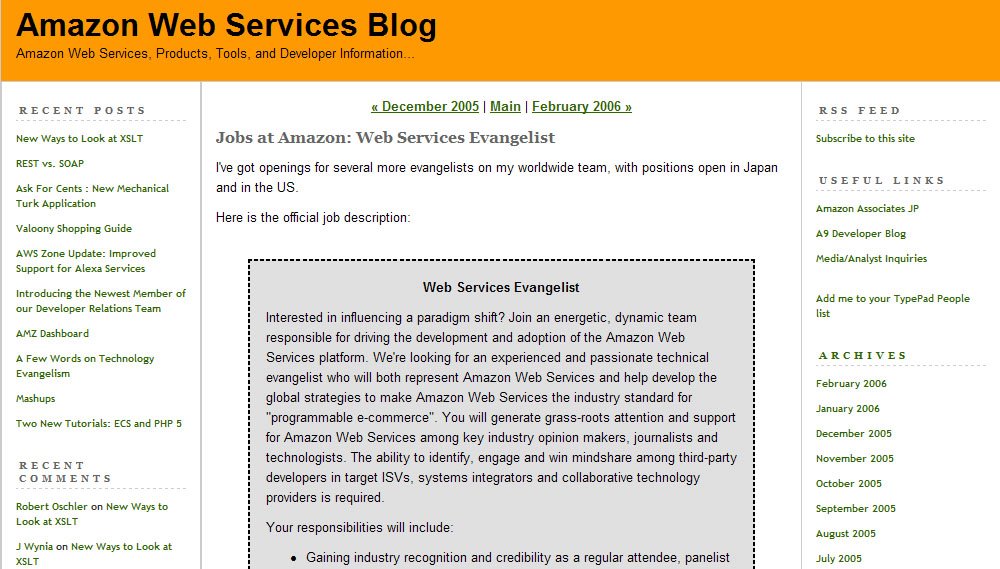
Here is an example of how Amazon use their blog to recruit a Web Services Evangelist.
Why do Web Services need Evangelists?
Will Bob Royce - iUpload - answer my question?

(Click on picture to enlarge)
Tonight, I posted a question on Bob Royce's blog as follows:
"Many teens are using sites, such as MySpace.com, posting personal information that leaves a trail detectable by future prospective employers. Even when bloggers on blogger.com delete posts, the entries are still accessible via google search. What responsibility do you think initiators of blog software, such as blogger.com, have to educating youngsters, and other users, on their sites prior to registration about the pitfalls of blogging blindly?"
Although I am in the process of emailing a number of executives with questions about blogs, this is the first comment that I have posted on an executive blog.
Monday, February 13, 2006
What does BusinessWeek say about "Blogspotting"?
Corporate blog search is a monster growth area!
Stephen Baker says: "Long story short: Corporate blog and media search will be a busy intersection in coming years. Lots of development, conflicts, alliances, and M&A" (Business Week).
Stephen Baker says: "Long story short: Corporate blog and media search will be a busy intersection in coming years. Lots of development, conflicts, alliances, and M&A" (Business Week).
Thursday, February 09, 2006
The Corporate Weblog Manifesto
Microsoft Geek - Scobleizer - gives advice on considering a weblog about your product or company:
- Tell the truth
- Be fast on good news or bad
- Use a human voice
- Make sure you support the latest software/web/human standards
- Have a thick skin
- Don't ignore slashdot [?]
- Talk to the grassroots first
- If you skrew up, acknowledge it
- Underpromise and over deliver
- If Doc Searls [?] says it or writes it, believe it
- Know the information gatekeepers
- Never change the URL of your weblog
- If your life is in turmoil and/or you're unhappy, don't write
- If you don't have the answers, say so
- Never lie
- Never hide information
- If you have information that might get you in a lawsuit, see a lawyer before posting, but do it fast
- Link to your competitors and say nice things about them
- BOGU. This means "Bend Over and Grease Up"
- Be the authority on your product/company
- Know who is talking about you
Subscribe to:
Posts (Atom)