
Today, Southwest are celebrating employees with blog post -- "Our Valentine's Day Heroes."
http://www.blogsouthwest.com/2007/02/13/our-valentines-day-heroes/
Past recipients of the Heroes of the Heart award are listed in this entry, representing a "deserving group or department that works behind-the-scenes at Southwest without direct contact with our External Customers."
It's interesting that Southwest have selected to link the Valentine's Day celebration with employee motivation.
How will other corporate bloggers seize the day?
Wells Fargo's Officers are still stuck in pursuit...
http://blog.wellsfargo.com/GuidedByHistory/
Showing posts with label Blogging_Communication. Show all posts
Showing posts with label Blogging_Communication. Show all posts
Tuesday, February 13, 2007


Tuesday, May 23, 2006
Bill Cara's Blog: Capital Markets

Today I took a look at Bill Cara's Blog [www.billcara.com] and find his daily analysis of capital markets most intriguing. The Trader Daily gives some background on Bill Cara -- here's the link: http://www.traderdaily.com/column13/index.html
Tuesday, April 04, 2006
Neville Hobson to the Rescue!
2 Responses to “The Hobson & Holtz Report - Podcast #125: April 3, 2006”
Feed for this Entry Trackback Address
1 Fiona Torrance Apr 4th, 2006 at 12:13 am
Hallo Neville
Today I’ve been reviewing your blog and I absolutely love the layout and how you present information.
I added a post from your blog that is relevant to my Independent Study at USC on Corporate Blogging: “Student Questions About Corporate Blogging” by Dr. Carl.
Recently, I’ve been trying to add RSS feeds, the ability to share Podcasts, and a StatCounter to my blog housed at Blogger.com. But I am new to this and find that when I follow instructions (such as at FeedBurner) and past the relevant HTML into my template, I lose information on my blog.
For someone starting to learn the use of this “new” technology, what is your advice in adding such features to a blog?
I look forward to hearing from you and — if you have time to look at my blog — any advice that you may have.
Thank you,
Fiona Torrance
http://bizblogreview.blogspot.com
2 neville Apr 4th, 2006 at 7:37 pm
Fiona, thanks for visiting and for your compliments.
Good questions re customizing your Blogger blog. I’m not that familiar with Blogger these days, I’m afraid, not having used it for a couple of years now. The best place for advice to start with would be the comprehensive help system, especially the section on templates.
As for the general advice you ask about, I think it really depends on what you want to achieve with your blog by adding features such as you mention (RSS, etc). In any event, FeedBurner has a terrific help forum where I’m sure you’ll find good advice from knowledgable people there re the specifics of how to add an FB feed to a Blogger blog. The same with StatCounter.
I’ve looked at your blog. It seems to me that you know more than your give yourself credit for!
1 Fiona Torrance Apr 5th, 2006 at 4:00 am
Thank you for this valuable feedback, Neville!
The reason I think it is valuable is because blogging is relatively new to me and there are so many techi things available to bloggers. Knowing what to add, why, and how takes a bit of deciphering.
My blog was initially set-up as a knowledge management system for an Independent Study on corporate blogs (BUAD 490 class at USC). I started off analyzing 32 blogs that are listed in my blogroll. Since then, I’ve included communications with corporate executives and student interactions from classes where I serve as a Teacher’s Assistant.
The blog became part of a research paper I submitted for USC’s undergraduate writing competition and it won first place in Professionalism. Thereafter, I took a chance and submitted it to USC’s Webfest 2006 and it won grand prize for that — which was amazing because I’m not technically a techi person and some of the websites presented are so creative!
My goal is to continue the blog when this semester ends. I would like to include links to articles (like the one I posted that is on your site) and I thought RSS feeds may help with this. Also, I want to be able to give audio discussions (bizblogcasts) about articles featured in the Wall Street Journal/Business Week about corporate blogging to create dialogue.
Knowing how to project quality content that readers can access easily(or in their preferred manner)and creating a stream of thought — whether people answer it or not — is important to me. I just want to express and put it out there to be part of the social computing evolution.
Blogger.com is a great site in many ways, but I have lost my content a number of times and had trouble publishing posts. Talk about a sleep problem! Would you suggest moving the blog, and if so, which blog do you think I would find more compatible?
Feed for this Entry Trackback Address
1 Fiona Torrance Apr 4th, 2006 at 12:13 am
Hallo Neville
Today I’ve been reviewing your blog and I absolutely love the layout and how you present information.
I added a post from your blog that is relevant to my Independent Study at USC on Corporate Blogging: “Student Questions About Corporate Blogging” by Dr. Carl.
Recently, I’ve been trying to add RSS feeds, the ability to share Podcasts, and a StatCounter to my blog housed at Blogger.com. But I am new to this and find that when I follow instructions (such as at FeedBurner) and past the relevant HTML into my template, I lose information on my blog.
For someone starting to learn the use of this “new” technology, what is your advice in adding such features to a blog?
I look forward to hearing from you and — if you have time to look at my blog — any advice that you may have.
Thank you,
Fiona Torrance
http://bizblogreview.blogspot.com
2 neville Apr 4th, 2006 at 7:37 pm
Fiona, thanks for visiting and for your compliments.
Good questions re customizing your Blogger blog. I’m not that familiar with Blogger these days, I’m afraid, not having used it for a couple of years now. The best place for advice to start with would be the comprehensive help system, especially the section on templates.
As for the general advice you ask about, I think it really depends on what you want to achieve with your blog by adding features such as you mention (RSS, etc). In any event, FeedBurner has a terrific help forum where I’m sure you’ll find good advice from knowledgable people there re the specifics of how to add an FB feed to a Blogger blog. The same with StatCounter.
I’ve looked at your blog. It seems to me that you know more than your give yourself credit for!
1 Fiona Torrance Apr 5th, 2006 at 4:00 am
Thank you for this valuable feedback, Neville!
The reason I think it is valuable is because blogging is relatively new to me and there are so many techi things available to bloggers. Knowing what to add, why, and how takes a bit of deciphering.
My blog was initially set-up as a knowledge management system for an Independent Study on corporate blogs (BUAD 490 class at USC). I started off analyzing 32 blogs that are listed in my blogroll. Since then, I’ve included communications with corporate executives and student interactions from classes where I serve as a Teacher’s Assistant.
The blog became part of a research paper I submitted for USC’s undergraduate writing competition and it won first place in Professionalism. Thereafter, I took a chance and submitted it to USC’s Webfest 2006 and it won grand prize for that — which was amazing because I’m not technically a techi person and some of the websites presented are so creative!
My goal is to continue the blog when this semester ends. I would like to include links to articles (like the one I posted that is on your site) and I thought RSS feeds may help with this. Also, I want to be able to give audio discussions (bizblogcasts) about articles featured in the Wall Street Journal/Business Week about corporate blogging to create dialogue.
Knowing how to project quality content that readers can access easily(or in their preferred manner)and creating a stream of thought — whether people answer it or not — is important to me. I just want to express and put it out there to be part of the social computing evolution.
Blogger.com is a great site in many ways, but I have lost my content a number of times and had trouble publishing posts. Talk about a sleep problem! Would you suggest moving the blog, and if so, which blog do you think I would find more compatible?
Monday, April 03, 2006
Blog for Traffic or to Communicate?
In the WSJ article, "The Inside View", William Bulkeley states that, "According to search-engine experts, that jump is partly because search engines like Google look for constantly changing content like blogs and rate it higher in search results than Web pages that aren't updated regularly."
This statement highlights two differences between blogs and websites:
1. Blog content is updated more frequently than Web pages
2. As a result, blogs are rated higher than Web pages on search engines
Depending on the blog objective, traffic generation (the amount of visitors to a blog) may or may not be that important. Some blogs are used for personal expression, such as my TourEsprit blog. If the purpose of a business blog is to promote products and services to increase sales, then traffic is important. The same is true for communication if the blog's purpose is to generate feedback from customers to improve products and services. Either way, traffic plays a role.
Microsoft's Director of Developer and Platform Evangelism -- Jeff Sandquist -- says, "I don't blog for traffic. I blog to communicate" (qtd in Bulkeley, WSJ 4/3/2006). Even Evangelists need an audience, but purely blogging for traffic to increase ratings on search engines may reduce the quality of the communication and dialogue on blogs.
Blogrolls, permalinks, and feeds -- who bloggers link to -- are also a means of generating traffic to a blog. About a week ago, I discovered an interesting dialogue published on Steve Rubel's Blog, Micropersuasion, after Steve (Senior VP with Edelman & Marketing Strategist) had removed a colleague's blog link from his blogroll:
 (Click on picture to enlarge)
The blog, in general, is not without its politics, even on the best of blogs. Steve Rubel's blog contains vast amounts of useful and interesting entries for students (faculty and others) to understand the use of technology in media and what makes a corporate blog successful.
To learn more, visit this link:
http://www.micropersuasion.com/2006/04/index.html
This statement highlights two differences between blogs and websites:
1. Blog content is updated more frequently than Web pages
2. As a result, blogs are rated higher than Web pages on search engines
Depending on the blog objective, traffic generation (the amount of visitors to a blog) may or may not be that important. Some blogs are used for personal expression, such as my TourEsprit blog. If the purpose of a business blog is to promote products and services to increase sales, then traffic is important. The same is true for communication if the blog's purpose is to generate feedback from customers to improve products and services. Either way, traffic plays a role.
Microsoft's Director of Developer and Platform Evangelism -- Jeff Sandquist -- says, "I don't blog for traffic. I blog to communicate" (qtd in Bulkeley, WSJ 4/3/2006). Even Evangelists need an audience, but purely blogging for traffic to increase ratings on search engines may reduce the quality of the communication and dialogue on blogs.
Blogrolls, permalinks, and feeds -- who bloggers link to -- are also a means of generating traffic to a blog. About a week ago, I discovered an interesting dialogue published on Steve Rubel's Blog, Micropersuasion, after Steve (Senior VP with Edelman & Marketing Strategist) had removed a colleague's blog link from his blogroll:
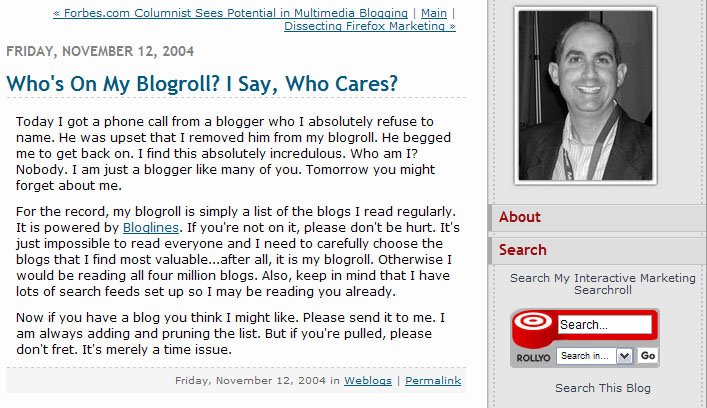 (Click on picture to enlarge)
The blog, in general, is not without its politics, even on the best of blogs. Steve Rubel's blog contains vast amounts of useful and interesting entries for students (faculty and others) to understand the use of technology in media and what makes a corporate blog successful.
To learn more, visit this link:
http://www.micropersuasion.com/2006/04/index.html
WSJ Inside View of Corporate Blogs
In today’s WSJ, William Bulkeley makes the statement: “Employee blogs can put a human face on companies. But that’s not always a good thing.”
* Because many corporate image specialists foresee a confusing array of corporate messages – some so sanitized that they lack credibility.
* Because lawyers fear that some employees’ thoughts may provide fodder for plaintiffs’ lawyers or give away company secrets or advice that a company prefers to sell.
Knowing these risks, corporate blogs are growing in number – Why?
Because being left out of the online community by not adopting this ‘burgeoning communications medium’ is a greater risk to business.
Corporate blogs provide the means to:
* Get to know companies (such as GM’s current challenges and changes)
* Contribute to company policy (such as Thomas Nelson who uses suggestions from comments on their company blog)
* Confront controversy (such as Cisco’s response to critics over their equipment used by the Chinese government to censor)
Companies need to establish blogging policies:
Companies and employees blog to communicate, but discretion is involved. With employees fired (“dooced”) for blogging, such as the reporter from Dover Post, companies are including blogging policies within company policy.
A survey of 1,000 employees by Employment Law Alliance found only 15% of companies have blogging policies. Blogging policies are needed to justify the firing of an employee for inappropriate blogging that harms the company.
Companies also need to require bloggers to use their real names because, “Many fear that a blogger who isn’t using his name will still be identifiable as a company employee and attract attention by denigrating rivals, blasting politicians or sneering at the boss”, reports Bulkeley. When bloggers take ownership of their posts it encourages constructive input and accuracy.
The credibility debate continues between top executives that may not seem believable compared with independent bloggers who are free to write their wants.
Companies can preserve credibility by publicly accepting criticism:
Yesterday, I discovered a great example of published public acceptance of criticism on the Hewlett Packard Executive Blog of Duncan Cambell – Vice President of Marketing, StorageWorks Division: (Click on picture to enlarge)
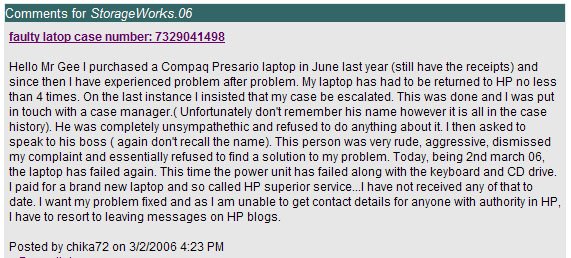
http://h20325.www2.hp.com/blogs/
Some corporations are open to this strategy to validate individuals who have concerns, and to take action on the criticisms where reasonable and appropriate.
Many companies, such as IBM and HP, expect bloggers to register before leaving comments that removes the “anonymity” issue, guides decent expression, and builds credibility.
In addition, many of companies also moderate the comments before they appear on the corporate blog.
The blogs mentioned in this article are listed in my blogroll for reference.
Sunday, April 02, 2006
Blogger.com Problem with Archives
There is currently a problem with Blogger.com in viewing past Archives. When you click on January thru April, you will notice that only the March and April posts are viewable. I am contacting Blogger.com about this problem.
Today -- 3 April 2006 -- Blogger Support emailed me the following which includes my response:
Thank you for your help, Blogger!
I've discovered that posts disappear when I try to add items like RSS feeds or StatCounters. Because of this difficulty, I've decided not to bother with this for now.
I pasted in my saved template and all is as it should be!
Thanks,
Fiona Torrance
On 4/3/06, Blogger Supportwrote:
Hi there,
Thanks for contacting Blogger Support.
Since we cannot always respondpersonally to every message we get, we encourage you to check BloggerHelp, where you can find answers to many common questions. Here are someof the top articles which could help you out:
CHANGES ARE NOT APPEARING ON YOUR BLOG
http://help.blogger.com/bin/answer.py?answer=639
A BLOG IS MISSING FROM YOUR DASHBOARD
http://help.blogger.com/bin/answer.py?answer=656
HELP WITH HTML, CSS, OR TEMPLATE CODE
http://help.blogger.com/bin/answer.py?answer=1116
If you don't see what you need in these articles, you can use the searchform in the upper right corner of any Blogger Help page. Be sure also tocheck our Status page and our Known Issues page. These cover many knownbugs and current operational problems.
BLOGGER STATUS
http://status.blogger.com/
KNOWN ISSUES
http://help.blogger.com/bin/answer.py?answer=791
You can also check out our Blogger Help Group, to talk to other users, askquestions, or see if anyone else has had the same issue as you.
BLOGGER HELP GROUP
http://groups.google.com/group/blogger-help
If your question or problem is not addressed anywhere in ourdocumentation, please simply reply to this message and let us know. Besure to include your Blogger username and the URL of your blog.
For future reference, note that you can attach your Blogger information toyour help request automatically by signing in and using our Help form,rather than sending direct emails. This makes it easier for us to help youmore efficiently.
This form is located here:
http://www.blogger.com/problem.gSincerely,Blogger Support
Today -- 3 April 2006 -- Blogger Support emailed me the following which includes my response:
Thank you for your help, Blogger!
I've discovered that posts disappear when I try to add items like RSS feeds or StatCounters. Because of this difficulty, I've decided not to bother with this for now.
I pasted in my saved template and all is as it should be!
Thanks,
Fiona Torrance
On 4/3/06, Blogger Support
Hi there,
Thanks for contacting Blogger Support.
Since we cannot always respondpersonally to every message we get, we encourage you to check BloggerHelp, where you can find answers to many common questions. Here are someof the top articles which could help you out:
CHANGES ARE NOT APPEARING ON YOUR BLOG
A BLOG IS MISSING FROM YOUR DASHBOARD
http://help.blogger.com/bin/answer.py?answer=656
HELP WITH HTML, CSS, OR TEMPLATE CODE
http://help.blogger.com/bin/answer.py?answer=1116
If you don't see what you need in these articles, you can use the searchform in the upper right corner of any Blogger Help page. Be sure also tocheck our Status page and our Known Issues page. These cover many knownbugs and current operational problems.
BLOGGER STATUS
http://status.blogger.com/
KNOWN ISSUES
http://help.blogger.com/bin/answer.py?answer=791
You can also check out our Blogger Help Group, to talk to other users, askquestions, or see if anyone else has had the same issue as you.
BLOGGER HELP GROUP
http://groups.google.com/group/blogger-help
If your question or problem is not addressed anywhere in ourdocumentation, please simply reply to this message and let us know. Besure to include your Blogger username and the URL of your blog.
For future reference, note that you can attach your Blogger information toyour help request automatically by signing in and using our Help form,rather than sending direct emails. This makes it easier for us to help youmore efficiently.
This form is located here:
http://www.blogger.com/problem.gSincerely,Blogger Support
Monday, March 27, 2006
Professional / Corporate Blog Training Need
The blog is a legitimate business communications tool that impacts our current social computing environment. Corporations need qualified professionals that can recognize challenges in this evolving environment, that can support corporate blogging needs through this transition, and that can successfully communicate corporate goals via the creation of an effective online presence -- the corporate blog.
Corporations use blogs as a platform to present and project a specific business goal -- internal, external, or both -- to generate on-going dialogue between businesses, employees, customers, and the general public.
Internal blogs serve internal corporate purposes, such as knowledge management, employee motivation strategies, or simply to reduce email. IBM's DeveloperWorks Blogs and Hewlett Packard Blogs are examples of corporate blogs used for internal purposes.
External blogs serve external corporate purposes, such as promotion of products or services. The Club Siemens blog is an example of such a corporate purpose. The corporate blog may also be used as a "press" platform to make announcements to businesses, customers, and the public about partnerships or organizational change.
Corporate blogging is a means for corporations to create a presence in the online community. But their success depends on their bloggers and their management of corporate blogs. Because few educational institutes actually train students to blog appropriately, effectively, and in a socially responsible manner, corporations rely on employees or independent-type contractors to meet their needs. Microsoft's hiring of Robert Scoble as an "Evangelist" is an example.
Corporate executives that blog have difficulty keeping their blogs current and responding to streams of questions and comments because they need to focus on other business objectives. Two particular executives have mentioned this:
1. Mohammed Amin of PriceWaterhouseCoopers wishes to blog weekly but is only managing fornightly posts.
2. AOL's Ted Leonis mentions having a flood of email originating from his blog to respond to.
Clearly, a niche market exists for professionally trained bloggers. Bloggers that can identify with specific corporate goals (internal or external) and tailor their blogging prowess to present those corporate goals via the corporate blog platform.
If business schools are not preparing business students to use the blog as a legitimate business communication tool, then corporations rely on training their own employees or contract with independent companies for these services.
Today -- at USC's Experimental Learning Lab (ELC) -- a team of students from BUAD 307 pitched a BizBlogRecruitment marketing plan to promote the services of a business blog recruitment [training and consultancy] company. The target audience being corporations that blog, those that plan to blog, and those not blogging. Included in the target audience are professional writers and bloggers. Here is the introductory slide:
 Our goal through this exercise is to show corporations that accepting and adapting to change, such as creating a tailored corporate blog, empowers them to maintain a competitive edge and connect with powerful online communities.
Although, as a team, we developed a marketing mix and plan for this service, we -- as business students -- have no formal classes in corporate/business blogging as a legitimate business communications tool on offer at our school.
As corporations need to recognize the changes in the social computing evironment and evolve their operations accordingly so that the organization and employees are prepared for interactions within the online environment. Similarly, business schools need to recognize the changes in the social computing environment and evolve their courses accordingly so that business students are prepared for the post-college online environment and developing business opportunities.
Corporations use blogs as a platform to present and project a specific business goal -- internal, external, or both -- to generate on-going dialogue between businesses, employees, customers, and the general public.
Internal blogs serve internal corporate purposes, such as knowledge management, employee motivation strategies, or simply to reduce email. IBM's DeveloperWorks Blogs and Hewlett Packard Blogs are examples of corporate blogs used for internal purposes.
External blogs serve external corporate purposes, such as promotion of products or services. The Club Siemens blog is an example of such a corporate purpose. The corporate blog may also be used as a "press" platform to make announcements to businesses, customers, and the public about partnerships or organizational change.
Corporate blogging is a means for corporations to create a presence in the online community. But their success depends on their bloggers and their management of corporate blogs. Because few educational institutes actually train students to blog appropriately, effectively, and in a socially responsible manner, corporations rely on employees or independent-type contractors to meet their needs. Microsoft's hiring of Robert Scoble as an "Evangelist" is an example.
Corporate executives that blog have difficulty keeping their blogs current and responding to streams of questions and comments because they need to focus on other business objectives. Two particular executives have mentioned this:
1. Mohammed Amin of PriceWaterhouseCoopers wishes to blog weekly but is only managing fornightly posts.
2. AOL's Ted Leonis mentions having a flood of email originating from his blog to respond to.
Clearly, a niche market exists for professionally trained bloggers. Bloggers that can identify with specific corporate goals (internal or external) and tailor their blogging prowess to present those corporate goals via the corporate blog platform.
If business schools are not preparing business students to use the blog as a legitimate business communication tool, then corporations rely on training their own employees or contract with independent companies for these services.
Today -- at USC's Experimental Learning Lab (ELC) -- a team of students from BUAD 307 pitched a BizBlogRecruitment marketing plan to promote the services of a business blog recruitment [training and consultancy] company. The target audience being corporations that blog, those that plan to blog, and those not blogging. Included in the target audience are professional writers and bloggers. Here is the introductory slide:
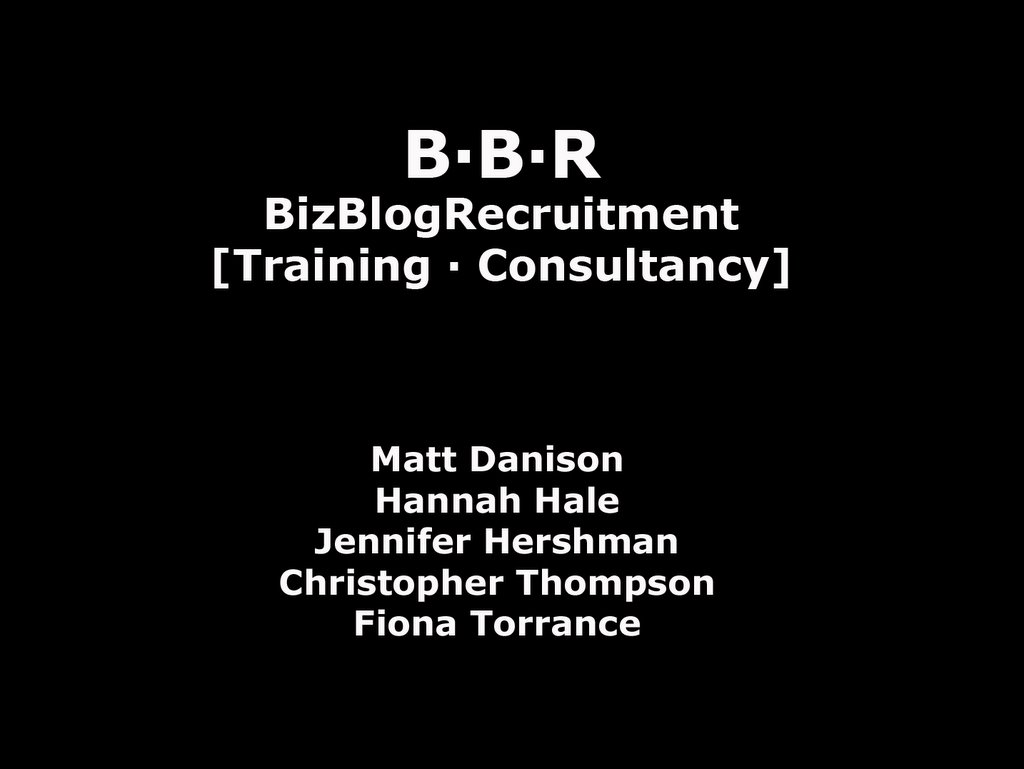 Our goal through this exercise is to show corporations that accepting and adapting to change, such as creating a tailored corporate blog, empowers them to maintain a competitive edge and connect with powerful online communities.
Although, as a team, we developed a marketing mix and plan for this service, we -- as business students -- have no formal classes in corporate/business blogging as a legitimate business communications tool on offer at our school.
As corporations need to recognize the changes in the social computing evironment and evolve their operations accordingly so that the organization and employees are prepared for interactions within the online environment. Similarly, business schools need to recognize the changes in the social computing environment and evolve their courses accordingly so that business students are prepared for the post-college online environment and developing business opportunities.
Thursday, March 23, 2006
Steps for CEO's to earn a good reputation with bloggers
Andy Sernovitz, CEO of Word Of Mouth Marketing Association (WOMMA), suggests five steps CEO's can follow to earn a good reputation with bloggers at this link:[http://www.imediaconnection.com/content/7780.asp].
The Five Steps:
1. Follow the conversation
2. Participate
3. Show that you are listening
4. Convert critics when you can
5. Write for the record
Sernovitz addresses how CEO's can reduce the confusion on whether to "Talk to them [bloggers], ignore them, treat them as press, treat them as customers, do your own blog, comment on their blog" with the following advice:
* The last word counts most
* Recent posts get indexed
* Everything lasts forever on Google
And what this means for CEO's is that:
* You'll never be able to control the blogosphere conversation
* You'll never be able to manage your own blog coverage like you could with the press
* You should respond participate (not plant and initiate), earn respect, and tell your story
* Let your views be heard and end the dialogue on a positive note
* Let your own words speak for themselves, do not try to manage what other people say
* Become part of the online community
Secret of Blog Relations = Customer Service
"It's working with a vocal group of individuals who each have their own particular concerns and needs. It's looking at situations, addressing them, and getting them fixed however you can", says Sernovitz.
So CEO's need to:
1. Treat bloggers like important customers
2. Earn their respect through service and respect
3. Use metrics to track positive and negative comments -- how quickly you respond to concerns
4. Look at the percentage of issues resolved successfully and for ways to improve the resolution rate
The conclusion says Sernovitz, "So if you want a good rep [reputation] in the blogosphere, you need to be good."
BE GOOD!
The Five Steps:
1. Follow the conversation
2. Participate
3. Show that you are listening
4. Convert critics when you can
5. Write for the record
Sernovitz addresses how CEO's can reduce the confusion on whether to "Talk to them [bloggers], ignore them, treat them as press, treat them as customers, do your own blog, comment on their blog" with the following advice:
* The last word counts most
* Recent posts get indexed
* Everything lasts forever on Google
And what this means for CEO's is that:
* You'll never be able to control the blogosphere conversation
* You'll never be able to manage your own blog coverage like you could with the press
* You should respond participate (not plant and initiate), earn respect, and tell your story
* Let your views be heard and end the dialogue on a positive note
* Let your own words speak for themselves, do not try to manage what other people say
* Become part of the online community
Secret of Blog Relations = Customer Service
"It's working with a vocal group of individuals who each have their own particular concerns and needs. It's looking at situations, addressing them, and getting them fixed however you can", says Sernovitz.
So CEO's need to:
1. Treat bloggers like important customers
2. Earn their respect through service and respect
3. Use metrics to track positive and negative comments -- how quickly you respond to concerns
4. Look at the percentage of issues resolved successfully and for ways to improve the resolution rate
The conclusion says Sernovitz, "So if you want a good rep [reputation] in the blogosphere, you need to be good."
BE GOOD!
Sunday, March 19, 2006
Steve Rubel says "Read the Freakin' Blogosphere"!
What does Steve mean?
It means that "the change or die mantra is the anthem of the Internet age, like it or not"
[http://www.micropersuasion.com/2006/03/read_the_freaki.html].
So the Blogosphere is ranting change -- what change?
Social computing as discussed in the forward-thinking Forrester Report, according to Steve, is revolutionizing old media into new channels, technology, and metrics.
Corporate blogging is one of those new media channels.
You can read more about Social Computing on the iMediaConnection site at this link:
[http://www.imediaconnection.com/content/8765.asp]
Why is corporate blogging necessary?
Corporations will need to prepare and engage in social computing as an asset, if not -- they will lose the competitive edge in promoting/selling/marketing their products and services. Corporate blogging is a means of maintaining and driving that edge.
Take Steve's advice: "Today the “manual” is living. It's the blogosphere. Read it and stay curious. Don't be complacent. "
It means that "the change or die mantra is the anthem of the Internet age, like it or not"
[http://www.micropersuasion.com/2006/03/read_the_freaki.html].
So the Blogosphere is ranting change -- what change?
Social computing as discussed in the forward-thinking Forrester Report, according to Steve, is revolutionizing old media into new channels, technology, and metrics.
Corporate blogging is one of those new media channels.
You can read more about Social Computing on the iMediaConnection site at this link:
[http://www.imediaconnection.com/content/8765.asp]
Why is corporate blogging necessary?
Corporations will need to prepare and engage in social computing as an asset, if not -- they will lose the competitive edge in promoting/selling/marketing their products and services. Corporate blogging is a means of maintaining and driving that edge.
Take Steve's advice: "Today the “manual” is living. It's the blogosphere. Read it and stay curious. Don't be complacent. "
Sunday, February 19, 2006
Harold Burson started blogging for Burson-Marsteller on Feb 15, 2006!

(Click on picture to enlarge)
Harold Burson is the founder of Burson-Marsteller, "a leading global public relations and public affairs firm" (www.burson-marsteller.com).
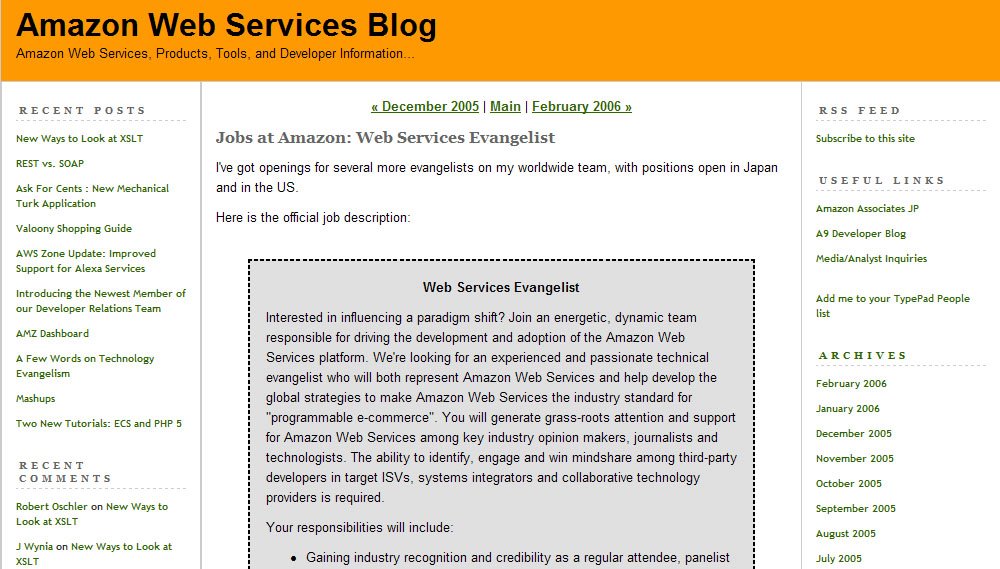
The blog recruitment device
 (Click on picture to enlarge)
Here is an example of how Amazon use their blog to recruit a Web Services Evangelist.
Why do Web Services need Evangelists?
Will Bob Royce - iUpload - answer my question?

(Click on picture to enlarge)
Tonight, I posted a question on Bob Royce's blog as follows:
"Many teens are using sites, such as MySpace.com, posting personal information that leaves a trail detectable by future prospective employers. Even when bloggers on blogger.com delete posts, the entries are still accessible via google search. What responsibility do you think initiators of blog software, such as blogger.com, have to educating youngsters, and other users, on their sites prior to registration about the pitfalls of blogging blindly?"
Although I am in the process of emailing a number of executives with questions about blogs, this is the first comment that I have posted on an executive blog.
Thursday, February 09, 2006
Interactive Communications Blog - Research for Coca-Cola Company
 Steve Rubel of Micro Persuasion discovered a Coca-Cola internal company blog on Typepad that now is password protected - you can view his comments at this link:
Source: http://www.micropersuasion.com/2004/10/coca_cola_marke.html
Frederick Wackå of W PR & Information AB also discusses this topic on his blog:
http://www.corporateblogging.info/2005/06/coca-cola-remove-link-to-us.asp
Coca-Cola's Australian "Unlimit Yourself" Launch:
(Started as one man's weblog - blog)
http://www2.coca-cola.com/ourcompany/wn20060203_zero.html
Discuss AT&T's Blogging Billboard:
 View these source blogs:
http://business2.blogs.com/business2blog/2006/01/att_blogging_ca.html
http://www.flickr.com/photos/spcoon/88076155/
Who took the photo? Where was it shot? And, does the blogger have a point?
The Corporate Weblog Manifesto
Microsoft Geek - Scobleizer - gives advice on considering a weblog about your product or company:
- Tell the truth
- Be fast on good news or bad
- Use a human voice
- Make sure you support the latest software/web/human standards
- Have a thick skin
- Don't ignore slashdot [?]
- Talk to the grassroots first
- If you skrew up, acknowledge it
- Underpromise and over deliver
- If Doc Searls [?] says it or writes it, believe it
- Know the information gatekeepers
- Never change the URL of your weblog
- If your life is in turmoil and/or you're unhappy, don't write
- If you don't have the answers, say so
- Never lie
- Never hide information
- If you have information that might get you in a lawsuit, see a lawyer before posting, but do it fast
- Link to your competitors and say nice things about them
- BOGU. This means "Bend Over and Grease Up"
- Be the authority on your product/company
- Know who is talking about you
Saturday, February 04, 2006
Blog Search Engines
Engines that assist "blogsurfers" to access blogs on different platforms. Here are some links:
http://www.google.com/blogsearch
http://www.technorati.com/blogs/
http://www.ljfind.com/
http://www.google.com/blogsearch
http://www.technorati.com/blogs/
http://www.ljfind.com/
The language of blogging
Blog:
Short for Weblog. A website that contains written material, links or photos being posted all the time, usually by one individual, on a personal basis.
(To) blog:
Run a blog or post material on one.
Blogger:
Person who runs a blog.
Blogosphere:
All blogs, or the blogging community.
Blogroll:
List of external links appearing on a blog, often links to other blogs and usually in a column on the homepage. Often amounts to a “sub-community” of bloggers who are friends.
Blogware:
Software used to run a blog.
Comment spam:
Like e-mail spam. Robot “spambots” flood a blog with advertising in the form of bogus comments. A serious problem that requires bloggers and blog platforms to have tools to exclude some users or ban some addresses in comments.
Content syndication:
How a site’s author or administrator makes all or part of its content available for posting on another website.
Moblog:
Contraction of “mobile blog.” A blog that can be updated remotely from anywhere, such as by phone or a digital assistant.
Permalink:
Contraction of “permanent link.” Web address of each item posted on a blog. A handy way of permanently bookmarking a post, even after it has been archived by the blog it originated from.
Photoblog:
A blog mostly containing photos, posted constantly and chronologically.
Podcasting:
Contraction of “iPod” and “broadcasting.” Posting audio and video material on a blog and its RSS feed, for digital players.
Post:
An item posted on a blog. Can be a message or news, or just a photo or a link. Usually a short item, including external links, that visitors can comment on.
RSS (Really Simple Syndication):
A way of handling the latest items posted on a website, especially suited for blogs because it alerts users whenever their favourite blogs are updated. It can also “syndicate” content by allowing other websites (simply and automatically) to reproduce all or part of a site’s content. Spreading fast, especially on media websites.
RSS aggregator:
Software or online service allowing a blogger to read an RSS feed, especially the latest posts on his favourite blogs. Also called a reader, or feedreader.
RSS feed:
The file containing a blog’s latest posts. It is read by an RSS aggregator/reader and shows at once when a blog has been updated.
Trackback:
A way that websites can communicate automatically by alerting each other that an item posted on a blog refers to a previous item.
Web diary:
A blog.
Wiki:
From the Hawaiian word “wikiwiki” (quick). A website that can be easily and quickly updated by any visitor. The word has also come to mean the tools used to create a wiki (wiki engines). Blogs and wikis have some similarities but are quite different.
Source: www.rsf.org - Reporters Without Borders
Short for Weblog. A website that contains written material, links or photos being posted all the time, usually by one individual, on a personal basis.
(To) blog:
Run a blog or post material on one.
Blogger:
Person who runs a blog.
Blogosphere:
All blogs, or the blogging community.
Blogroll:
List of external links appearing on a blog, often links to other blogs and usually in a column on the homepage. Often amounts to a “sub-community” of bloggers who are friends.
Blogware:
Software used to run a blog.
Comment spam:
Like e-mail spam. Robot “spambots” flood a blog with advertising in the form of bogus comments. A serious problem that requires bloggers and blog platforms to have tools to exclude some users or ban some addresses in comments.
Content syndication:
How a site’s author or administrator makes all or part of its content available for posting on another website.
Moblog:
Contraction of “mobile blog.” A blog that can be updated remotely from anywhere, such as by phone or a digital assistant.
Permalink:
Contraction of “permanent link.” Web address of each item posted on a blog. A handy way of permanently bookmarking a post, even after it has been archived by the blog it originated from.
Photoblog:
A blog mostly containing photos, posted constantly and chronologically.
Podcasting:
Contraction of “iPod” and “broadcasting.” Posting audio and video material on a blog and its RSS feed, for digital players.
Post:
An item posted on a blog. Can be a message or news, or just a photo or a link. Usually a short item, including external links, that visitors can comment on.
RSS (Really Simple Syndication):
A way of handling the latest items posted on a website, especially suited for blogs because it alerts users whenever their favourite blogs are updated. It can also “syndicate” content by allowing other websites (simply and automatically) to reproduce all or part of a site’s content. Spreading fast, especially on media websites.
RSS aggregator:
Software or online service allowing a blogger to read an RSS feed, especially the latest posts on his favourite blogs. Also called a reader, or feedreader.
RSS feed:
The file containing a blog’s latest posts. It is read by an RSS aggregator/reader and shows at once when a blog has been updated.
Trackback:
A way that websites can communicate automatically by alerting each other that an item posted on a blog refers to a previous item.
Web diary:
A blog.
Wiki:
From the Hawaiian word “wikiwiki” (quick). A website that can be easily and quickly updated by any visitor. The word has also come to mean the tools used to create a wiki (wiki engines). Blogs and wikis have some similarities but are quite different.
Source: www.rsf.org - Reporters Without Borders
Monday, January 30, 2006
10 Rules for Corporate Blogs and Wikis
MarketingProfs list the following 10 Rules for Corporate Blogs and Wikis (link on sidebar and signup is free):
1. Be authentic
2. Be an unmatched source
3. Once you start, don't stop
4. Keep it relevant
5. Measure your effectiveness
6. Monitor other blogs
7. Trust your employees
8. Use blogs for knowledge management
9. Use wikis for employee and customer collaboration
10. Develop an organizational content strategy now
Source: 10 Rules for Corporate Blogs and Wikisby Nick Wreden April 13, 2004
1. Be authentic
2. Be an unmatched source
3. Once you start, don't stop
4. Keep it relevant
5. Measure your effectiveness
6. Monitor other blogs
7. Trust your employees
8. Use blogs for knowledge management
9. Use wikis for employee and customer collaboration
10. Develop an organizational content strategy now
Source: 10 Rules for Corporate Blogs and Wikisby Nick Wreden April 13, 2004
Sunday, January 29, 2006
5 W's - Who . What . Where . When . Why .
Who?
The study focuses on Corporations and those using or learning about blogs as a buisness communications tool.
What?
The use of blogs as a business communications tool.
Where?
An assessment of blogs on the internet and those involved locally, nationally (US), and internationally with the use of blogs.
When?
The study covers the origin of blogs to their current use and future evolution. However, the Independent study runs for the Spring 2006 semester - Jan. 10, 2006 to April 25, 2006.
Why?
Blogs impact corporations who use business communications in all spheres of business, employees in the workplace, traditional print, and so forth. Learning about the effective use of blogs as a business communications tool is valuable to the success of organizations and individuals.
The study focuses on Corporations and those using or learning about blogs as a buisness communications tool.
What?
The use of blogs as a business communications tool.
Where?
An assessment of blogs on the internet and those involved locally, nationally (US), and internationally with the use of blogs.
When?
The study covers the origin of blogs to their current use and future evolution. However, the Independent study runs for the Spring 2006 semester - Jan. 10, 2006 to April 25, 2006.
Why?
Blogs impact corporations who use business communications in all spheres of business, employees in the workplace, traditional print, and so forth. Learning about the effective use of blogs as a business communications tool is valuable to the success of organizations and individuals.
Subscribe to:
Posts (Atom)



